brands
JET Spindle Sanders: Choosing Bench or Floor Support
Choose the JET JBOS-5 when a 77-pound benchtop station, 14-1/2-inch-square tilting table and included small-diameter spindles fit the work. Move to the 216-pound JOSS-S only when its floor cabinet, 24-1/2-inch-square table, bidirectional tilt and included ten-size system solve a documented support or radius problem. Both exact retained offers are useful shopping paths, but the machines use different sleeves, inserts and installation plans.
As an Amazon Associate I earn from qualifying purchases. How affiliate links work.
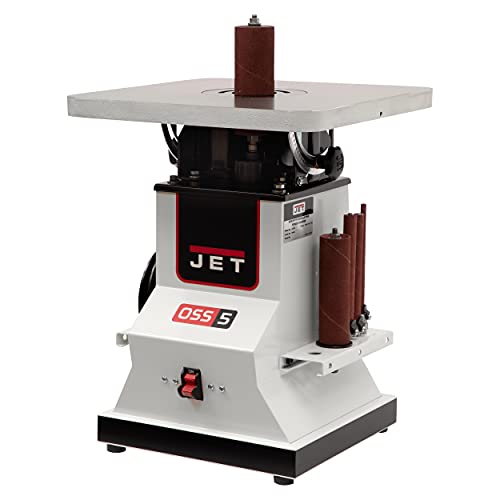 JET Benchtop Oscillating Spindle Sander, 1/2 HP, 115V 1Ph (Model JBOS-5)Check Amazon offer
 JET Oscillating Spindle Sander, 1720 RPM, 1 HP, 115V 1Ph (Model JOSS-S)Check Amazon offer
Compare the approaches
| Decision | First option | Second option |
|---|---|---|
| Support format | JBOS-5: benchtop, about 77 lb, 14-1/2-in.-square table | JOSS-S: floorstanding, 216 lb, 24-1/2-in.-square table |
| Included diameters | JBOS-5: five sizes, 1/4 through 2 in.; 3 in. optional | JOSS-S: ten included sizes, 1/4 through 4 in. |
| Sleeve lengths | JBOS-5: 6 in. at 1/4–5/8; 5-1/2 in. at 1-1/2–2 and optional 3 in. | JOSS-S: 6 in. at 1/4–5/8; 9 in. at 3/4–4 in. |
| Table and extraction | JBOS-5: 0–45° table; 2-in. port | JOSS-S: 45° forward / 15° back; 4-in. port and 300-CFM manual minimum |
| Stop rule | Stop if the optional 3-in. package or a permanent bench cannot be resolved | Stop if floor space, circuit, hose route or work support has not been planned |
Start with reliable model identification
The official JET titles identify the JBOS-5 as a benchtop oscillating spindle sander and the JOSS-S as a floor model. The manufacturer also provides a spindle-sander parts category. Some generic descriptive text on product pages can be less specific than the model title, so use the linked owner's manual and specification record when checking a technical detail. Keep the stock number together with the model name. This is a better foundation for research than copying a retailer paragraph that may have been reused across several sanding categories.
Why a bench machine may be enough
If you make small shaped components and have a sturdy bench at a comfortable height, a benchtop format can organize the job without a separate floor station. Evaluate how much clear surface remains on each side of the sander. A machine can fit physically while leaving too little room to rotate an elongated part. Also consider whether the bench carries vibration from other equipment or must be cleared for assembly. A dedicated corner with stored sleeves and a ready extraction hose may improve convenience more than stepping up to a larger format that has nowhere sensible to live.
When floor space buys useful capacity
Investigate the floor family when the work frequently challenges your current support arrangement or when sanding deserves a permanent location in the production sequence. Lay out the complete operation: rough shaping, sanding, inspection, and storage of finished parts. A floor machine should reduce handling problems rather than merely occupy an open rectangle. Look at the approach path for the biggest component and at the operator's standing position. If the machine will need a mobile base, check the manufacturer's provisions and the resulting working height rather than assuming any available base is suitable.
Match the accessory system to your curves
List the tightest internal radius and the tallest edge you need to sand. These establish questions about spindle diameter, usable abrasive height, and support through the full motion. Check which spindle assemblies are supplied and which are optional for the specific JET model. An optional larger assembly can also require its own table insert, so the sleeve alone may not complete the setup. Keep each mechanical assembly labeled if several machines share a shop. A familiar-looking thread or taper is not a reliable basis for trying a component from another manufacturer.
Evaluate an older JET as an individual machine
A used sander should be identified by its plate and evaluated against its own manual. Request clear photographs of the complete accessory set and the table's adjustment hardware. During an appropriate demonstration, confirm that the operator can show both rotation and the intended oscillating movement. Cosmetic wear does not tell the whole story, and a freshly painted cabinet does not establish mechanical condition. Before making a decision, identify any missing proprietary component and investigate an actual replacement path. The economics of a used purchase change quickly when a necessary assembly cannot be sourced.
Choose the setup you will use consistently
The sensible JET choice is the one that supports your normal parts, offers the required curve access, and fits the way work moves through your shop. Compare the exact bench and floor documentation only after these requirements are clear. Include extraction, mounting, accessories, and consumables in the plan. Treat manufacturer specifications as design information, not a promise about sanding speed in your wood species. The bench-versus-floor comparison comes from documentation rather than hands-on ranking. Request current inventory and pricing from the dealer for the exact configuration shortlisted.
Questions about JET Spindle Sanders: Choosing Bench or Floor Support
What is the main JET family distinction?
The manufacturer identifies JBOS-5 as benchtop and JOSS-S as floor model. Match the support format to your work and installation space.
Where should I verify a disputed specification?
Use the exact model’s official manual and specification record, especially if a general product description appears inconsistent.
Are additional spindle sizes always a sleeve-only purchase?
No. A different size may require a complete spindle assembly and matching table insert. Check the model documentation.