models
JET JBOS-5: Sleeves, Setup and Buying Considerations
Choose the JET JBOS-5 when a permanent benchtop station, a 0–45-degree tilting cast-iron table and included 1/4- or 5/8-inch spindles answer real project needs. Stop if you require a 3-inch diameter in the shipped package: JET sells that assembly and its insert separately. The narrow spindle assemblies and larger rubber drums also use different sleeve lengths, so the manual's accessory table—not one headline dimension—is the replacement reference.
As an Amazon Associate I earn from qualifying purchases. How affiliate links work.
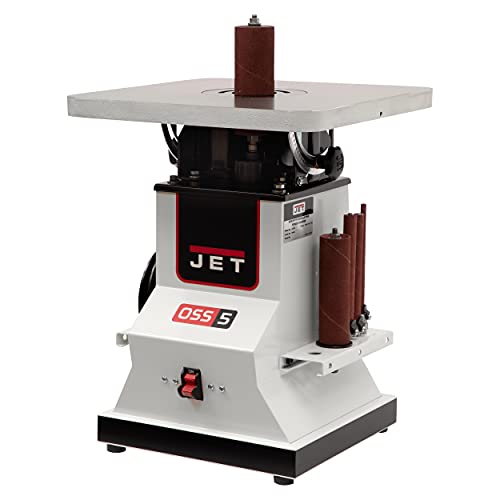 JET Benchtop Oscillating Spindle Sander, 1/2 HP, 115V 1Ph (Model JBOS-5)Check Amazon offer
Documented specifications for JET JBOS-5
| Model | Family | Sleeve height (in) | Diameters (in) | Belt size | Table tilt | Offer |
|---|---|---|---|---|---|---|
| JET JBOS-5 | spindle | Not confirmed | 0.25, 0.5, 0.625, 1.5, 2 | None documented | 45° | Check Amazon offer |
- Machine weight
- 75.6 lb
- Documented spindle speed
- 1725 RPM
- Dust port
- 2 in
Mixed sleeve lengths: 6 inches for .25/.5/.625 diameters; 5.5 inches for 1.5/2 and optional 3.
3-inch spindle optional, not included in diameter list.
Current title says 115V while the May 2026 manual specifies 110V and its parts list says 115V; verify nameplate, serial range and circuit.
Dimensions alone do not confirm spindle assembly fit.
What the five supplied diameters allow
JET lists 1/4-, 1/2-, 5/8-, 1-1/2- and 2-inch spindles for the JBOS-5. That selection favors both tight internal details and broader furniture curves. The optional 3-inch assembly is a separate purchase, with an appropriate insert also needed. A small spindle can enter a narrow opening, but access alone does not make it the best finishing choice.
Imagine shaping a broad scallop in an apron. A narrow drum touches a small patch and makes it easy to introduce little hollows while chasing the pencil line. A larger drum distributes contact over more of the arc. For a tight notch, reverse the priority: choose a diameter that enters freely and leaves room to guide the work, without attempting to wedge the opening around the abrasive.
Order sleeves by the assembly, not one headline length
The JET manual's accessory table specifies 6-inch sleeves for the 1/4-, 1/2- and 5/8-inch sizes, and 5-1/2-inch sleeves for the 1-1/2-, 2- and optional 3-inch sizes. Accordingly, a single sleeve-height field would misrepresent this machine. Match the exact diameter and assembly type before selecting a replacement.
Keep a written inventory next to the stored spindles, identifying diameter, length, grit and the relevant part number. A mixed pack advertised for benchtop sanders may omit the smallest sizes or contain a shorter common length. Do not infer that a complete spindle from another brand will fit because its abrasive dimensions match: threads, mounting shoulders, clamp design and table clearance are separate compatibility questions.
Use the table angle as a measured setup
The table tilts through 45 degrees. For a square edge, verify the table against the spindle using a reliable square, with the machine disconnected. When an abrasive seam interferes with the check, rotate the assembly by hand and compare more than one position. A scale is a useful starting point for a bevel; a sample cut or sanded offcut establishes the actual result.
On a curved bevel, the angle depends on keeping the reference face supported while the contour changes direction. Mark which face belongs on the table so paired parts are not accidentally mirrored. Stop and compare the developing bevel at several locations rather than assuming one good-looking section proves the entire curve is consistent. Use the insert specified for the spindle and tilted-table configuration.
Plan a permanent bench position
The published product sheet specifies a 2-inch dust outlet and approximately 76 pounds of machine weight; the linked manual gives 77 pounds. Treat that small discrepancy as a documentation difference, not a reason to design a marginal bench. Give the sander secure support, clearance around the longest workpiece, and a hose route that will not pull on it.
Before building storage beneath the bench, rehearse the path of your largest curved panel with the machine off. The panel may need much more surrounding space than the sander's compact footprint suggests. Put abrasive storage close enough to encourage timely grit changes, but away from the immediate dust stream. A usable layout often matters more to daily work than another accessory diameter.
Read specification conflicts before buying used
The current product title says 115V, while the May 2026 manual specifies 110V and its parts list again labels the motor 115V; the page/manual also differ slightly on weight. Use the actual nameplate and the manual appropriate to the machine's serial range for electrical planning. Current generic marketing also refers to belts and discs; the JBOS-5 is a spindle sander, so those templated descriptions should not guide accessory purchases.
For a secondhand machine, ask to see every spindle, insert and retaining component laid out. Inspect the table, mounting threads and sleeve clamps before evaluating finish quality. A missing proprietary assembly can matter more than worn abrasive paper. Confirm that rotation and vertical oscillation both function, and compare a safely sanded sample against a square rather than relying on a seller's description of smooth operation.
Questions about JET JBOS-5: Sleeves, Setup and Buying Considerations
Does every JBOS-5 spindle use a 6-inch sleeve?
No. The linked manual lists 6-inch sleeves for the three smallest diameters and 5-1/2-inch sleeves for the larger drums. Order by individual assembly.
Is JBOS-35 a different JET sander?
The verified JBOS-5 accessory page inconsistently uses JBOS-35 in its title while identifying JBOS-5 compatibility. That title does not establish a separate machine model.
Can a matching-diameter drum from another machine fit?
Matching abrasive diameter is insufficient. Verify the spindle mounting, sleeve retention, length and insert clearance with JET before treating another assembly as compatible.