comparisons
JET JBOS-5 vs RIKON 50-300: Compare the Spindle Sets
Small inside curves can separate the JET JBOS-5 from the RIKON 50-300 before you compare their substantial benchtop frames and tilting tables. JET includes notably small spindle sizes; RIKON supplies a different progression of diameters. Match those sets to full-size drawings of your parts. Manufacturer specifications and JET's operating manual support this comparison; mass and brand reputation do not establish sanding quality, vibration or service life.
As an Amazon Associate I earn from qualifying purchases. How affiliate links work.
Both exact compared models have retained catalog matches: JET JBOS-5 and RIKON 50-300. Verify the complete package and revision before ordering; equal diameter labels do not establish interchangeable spindle assemblies, abrasives, inserts, washers or hardware.
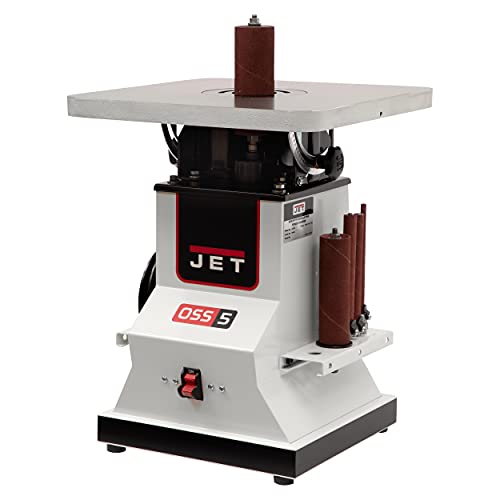 JET Benchtop Oscillating Spindle Sander, 1/2 HP, 115V 1Ph (Model JBOS-5)Check Amazon offer
 Rikon Power Tools 50-300, Oscillating Spindle SanderCheck Amazon offer
Side-by-side buying comparison
| Model | Family | Sleeve height (in) | Diameters (in) | Belt size | Table tilt | Offer |
|---|---|---|---|---|---|---|
| JET JBOS-5 | spindle | Not confirmed | 0.25, 0.5, 0.625, 1.5, 2 | None documented | 45° | Check Amazon offer |
| RIKON 50-300 | spindle | 4.5 | 0.5, 0.75, 1, 1.5, 2 | None documented | 45° | Check Amazon offer |
| RIKON 50-320 | spindle | 4.5 | 0.5, 0.75, 1, 1.5, 2, 3 | None documented | 0° | No exact offer matched |
| JET JOSS-S | floor | Not confirmed | 0.25, 0.375, 0.5, 0.625, 0.75, 1, 1.5, 2, 3, 4 | None documented | 45° | Check Amazon offer |
Check the model guides for regional variations and source qualifications. Table dimensions do not establish performance or material suitability.
Compare the approaches
| Decision | First option | Second option |
|---|---|---|
| Included spindle diameters | JET: 1/4, 1/2, 5/8, 1-1/2 and 2 in | RIKON: 1/2, 3/4, 1, 1-1/2 and 2 in |
| Included abrasive lengths | Mixed: 6 in at 1/4, 1/2 and 5/8 in; 5-1/2 in at 1-1/2 and 2 in | 4-1/2 in listed for the included range; length is not automatic workpiece capacity |
| Optional maximum | 3 in assembly appears as optional equipment, not in the included set | 3 in is the listed maximum allowed but requires an optional assembly |
| Table and motion | 0-45 degree table; 1 in stroke at 30 oscillations/min and 1,725 RPM | 0-45 degree table; 15/16 in stroke at 29 oscillations/min and 1,700 RPM |
| Evidence limit | Current webpage electrical and weight data differ from the linked manual; verify the nameplate and revision | A listed optional diameter does not prove the spindle, insert, abrasive or retaining hardware is included |
| Stop rule | Stop if the required curve needs an unlisted intermediate diameter or the mixed sleeve-height system is unresolved | Stop if the required curve needs JET's included 1/4 or 5/8 in size, or if optional 3 in hardware is being counted as included |
Begin with the tightest curve on your drawings
JET lists JBOS-5 spindle diameters of 1/4, 1/2, 5/8, 1-1/2, and 2 inches. RIKON lists 50-300 diameters of 1/2, 3/4, 1, 1-1/2, and 2 inches. That difference can be decisive if a project needs the smaller included JET spindle, or if RIKON's intermediate sizes better match frequently repeated curves. It is not simply a count of five versus five. Check actual access and safe work support as well as diameter; a small sleeve does not make every delicate or trapped shape suitable.
Distinguish included equipment from optional capacity
RIKON's specification page identifies a maximum allowed spindle diameter larger than its largest included spindle. Treat an allowed optional size and an included accessory as separate facts when comparing the purchase. The extra assembly, matching insert, and replacement abrasive may affect the total cost. Apply the same discipline to JET options in its manual. Do not add a sleeve or spindle based on apparent thread fit, and do not assume that the two machines use interchangeable assemblies because some diameter labels match.
Examine the table arrangement for angled components
Both models document table adjustment to 45 degrees. The practical question is how your particular component remains supported at the required setting and which inserts the instructions specify. Compare access to the lock and adjustment mechanism with the machine in its intended bench position. For a batch of matched parts, plan how you will verify the angle and restore square afterward. The presence of a tilting table establishes a capability, but it does not establish repeatability or flatness without checking the actual setup.
Read motion specifications as descriptions
JET lists a one-inch oscillation stroke and 30 oscillations per minute for the JBOS-5. RIKON lists a 15/16-inch stroke and 29 per minute for the 50-300. These close but distinct specifications do not justify ranking finish quality. Abrasive condition, workpiece geometry, material, support, and feed remain influential. Check usable sanding height in the matching instructions rather than interpreting the sleeve length as automatic capacity. No stopwatch, temperature, finish, or endurance measurements were performed for this comparison.
Plan a dedicated station and ownership route
Evaluate the machine weight and approved installation before deciding to lift either model in and out of storage. A permanent bench position may be more convenient than repeated transport. Allow access for spindle storage, table movement, and the dust connection. Read service and warranty terms for your intended use and locate model-specific replacement parts. JET's manual distinguishes some coverage conditions by use, illustrating why a headline warranty duration should not replace reading the applicable terms before assigning it value.
Leave the two-model shortlist when the format is wrong
Move to the RIKON 50-320 branch when a 20-pound fixed-table machine and an included 3-inch drum matter more than table tilt or bench-station mass. Move to the JET JOSS-S branch only when a 216-pound floor machine, 24-1/2-inch-square table, bidirectional tilt, 4-inch dust port and included 1/4-through-4-inch system solve recurring support or radius problems. These are format changes, not a four-model performance ranking. The retained catalog has no exact 50-320 offer; the current model-unspecified RIKON listing must not inherit 50-320 specifications.
The JOSS-S manual further separates its consumables from both benchtop candidates: 1/4-through-5/8-inch assemblies use 6-inch sleeves, while 3/4-through-4-inch assemblies use 9-inch sleeves. Its current product page contains belt/disc boilerplate that conflicts with the drum specification and direct-drive spindle manual, so use the model manual rather than those generic marketing bullets.
Let the spindle set and supported workflow decide
Choose the JBOS-5 for further investigation when its smaller included diameters answer a documented project requirement. Favor examining the 50-300 when its diameter progression and table arrangement align better with the components you make. If both cover the work, compare the exact package, current complete cost, local support, and practical installation. Do not use generic wording about industrial strength as evidence of a duty rating. The stronger decision is based on the manufacturer's actual spindle-sander documentation and a realistic picture of the work passing through your shop.
Lay out your tightest concave pattern at full size and compare it with JET's smallest included spindle. Then check the more common, less-tight curves against RIKON's intermediate diameters. Leave room on the drawing for the surrounding work to move, because a drum entering the curve does not by itself establish controllable access. This makes the included set relevant to your actual shapes instead of treating the number of sizes as a score.
Questions about JET JBOS-5 vs RIKON 50-300: Compare the Spindle Sets
Which model includes the smallest spindle?
JET lists a 1/4-inch spindle with the JBOS-5. RIKON’s included 50-300 set starts at 1/2 inch. Confirm the package and safe work support for the operation you intend.
Does the RIKON include its largest allowed spindle?
The maximum allowed diameter and included set are different entries on RIKON’s page. Check the current optional assembly and matching insert requirements before counting that capacity in the delivered package.
Do the oscillation figures prove a performance difference?
No. The published stroke and rate describe motion. They do not by themselves establish which machine leaves a better finish, runs cooler, or lasts longer under your workload.