buying guides
Heavy-Duty Spindle Sanders: Evaluate the Real Workload
Heavy-duty is an imprecise shopping term. It may refer to mass, construction, motor design, or simply a retailer's description. A useful purchase starts with a defined workload: part size, material, sanding time, and frequency of adjustment. Use that workload to compare documented capabilities and support. Do not treat a benchtop machine's substantial weight as proof of unrestricted production duty.
As an Amazon Associate I earn from qualifying purchases. How affiliate links work.
The offers match the JET JBOS-5 and RIKON 50-300 benchtop candidates discussed below. Their documented features are not a tested duty-cycle or durability rating.
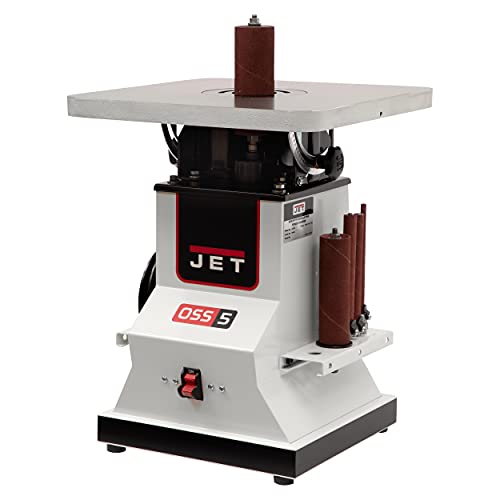 JET Benchtop Oscillating Spindle Sander, 1/2 HP, 115V 1Ph (Model JBOS-5)Check Amazon offer
 Rikon Power Tools 50-300, Oscillating Spindle SanderCheck Amazon offer
Describe the workload in practical terms
Record the largest component, its edge height, and the time spent sanding a typical batch. Note whether you are refining a close bandsaw cut or trying to remove considerable excess material. List the sleeve changes and table-angle changes the batch requires. These details help distinguish a capacity problem from a process problem. If rough cutting leaves too much waste, improving that upstream step can be more useful than asking a larger sanding motor to remove it.
Inspect substantial benchtop candidates
JET JBOS-5 and RIKON 50-300 are manufacturer-documented spindle sanders with tilting tables and substantial benchtop construction. They are appropriate comparison points when a dedicated station matters. Their published specifications are starting evidence, not an endurance test. Compare the actual table support, included spindle diameters, accessible controls, and installation requirements. If your work exceeds a benchtop machine's approved scope, investigate a suitably rated larger machine rather than interpreting the phrase heavy-duty as a substitute for explicit manufacturer guidance.
Prioritize repeatable angles and component support
Demanding furniture work may depend more on maintaining an angle over multiple components than on maximum removal speed. Evaluate how the table locks, how square can be checked, and what support remains around the selected drum. Large curved parts can act as levers if they extend far beyond the table. Determine whether the work can be supported as instructed without forcing it against the abrasive. A larger motor cannot compensate for a setup that lets the edge rock or the part twist.
Plan for service and scheduled upkeep
Read the maintenance section and locate the parts diagrams before purchase. Find out which adjustments are routine for the operator and which concerns should go to service. Identify replaceable switches, inserts, and wear components without assuming every listed part is currently in stock. Keep the model and serial information with purchase records. For a shop that depends on the machine, a clear service route and obtainable consumables may matter more than a small difference in nominal speed or a promotional accessory bundle.
Assess extraction for the actual sanding volume
Repeated sanding makes dust management and housekeeping an ongoing process. Match the machine's extraction requirements to the system, including hose losses and the manufacturer's connection instructions. A large dust port is not a measured capture rating, and a clean tabletop does not demonstrate control of fine airborne dust. Consider where collected material goes and how the system will be maintained during the workday. The sanding station is productive only when the surrounding process can support the quantity of work you intend to feed it.
Avoid using ratings as a race
Horsepower, spindle speed, oscillation rate, and stroke each describe something different. They cannot be added into a credible performance score. A higher oscillation number does not prove a better finish, and a slower spindle is not inherently weak. Evaluate suitability with representative work where a properly arranged demonstration is available, using the same stock and equivalent fresh abrasives. Without that evidence, frame the decision around documented capacity, ergonomics, maintenance, and support rather than claiming one machine wins an unperformed stress test.
For a batch of chair components, record each sleeve-diameter change and angled-edge check. Accessible adjustments and storage may reduce interruptions more than a modest difference in nominal motor rating. If properly prepared stock and suitable abrasives still place repeated strain on the machine, ask the manufacturer whether that workload is appropriate. Increasing pressure or extending a running session does not establish that the machine is rated for the job.
Questions about Heavy-Duty Spindle Sanders: Evaluate the Real Workload
Does heavy construction guarantee production suitability?
No. Construction can contribute to stability, but approved use and duty expectations must come from the manufacturer. Match the machine to a defined workload and ask support about unclear limits.
Which matters more, power or table size?
Either can become the limiting factor. A table that cannot support the part is a fundamental problem, while a suitable setup still needs enough capacity for the intended material and removal task.
Should a commercial shop compare warranty conditions?
Yes. Read the current terms for the exact model and intended use, including eligibility and exclusions. Do not assume that coverage advertised for a home workshop applies unchanged to commercial operation.