buying guides
Best Spindle Sander: Choose by the Work You Do
The best spindle sander fits your tightest inside curve, supports the workpiece and produces the square or beveled edge your projects need. This six-model shortlist compares fixed-table, tilting-table and belt/spindle machines using manufacturer specifications, with exact Amazon offers for five models. Start with those physical requirements, then check the complete sanding station: abrasives, dust connection and bench space. Published horsepower alone cannot rank sanding performance; these choices are based on documentation, not hands-on tests.
As an Amazon Associate I earn from qualifying purchases. How affiliate links work.
The retained catalog provides exact offers for WEN 6510T, WEN AT6535, WEN 6524, RIKON 50-300 and JET JBOS-5. Grizzly G0739 is a source-only candidate with no matching Amazon listing; no similar listing is presented as a substitute.
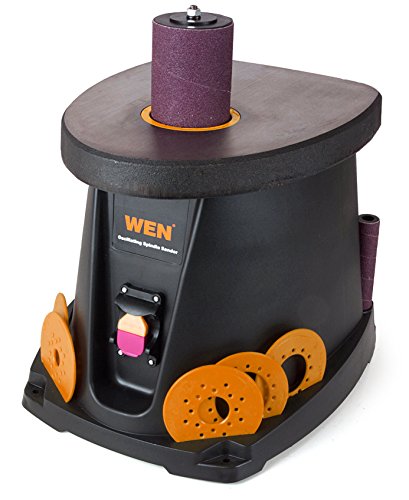 WEN 6510T 3.5 Amp Oscillating Spindle Sander,BlackCheck Amazon offer
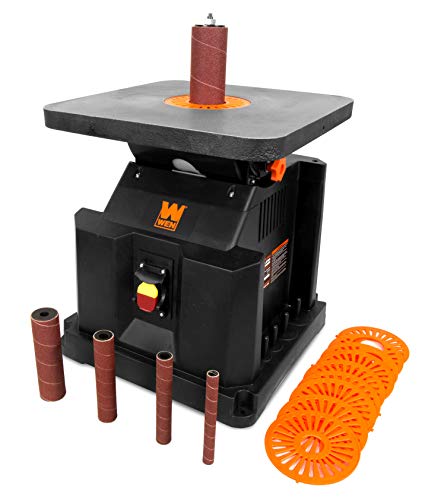 WEN AT6535 3.5-Amp Oscillating Spindle Sander with Extra Large Beveling Table TopCheck Amazon offer
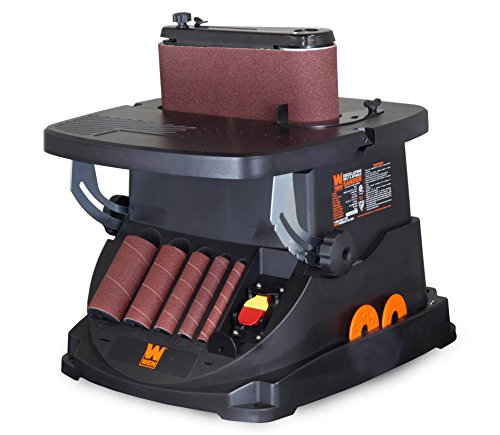 WEN 6524 Oscillating Belt and Spindle SanderCheck Amazon offer
 Rikon Power Tools 50-300, Oscillating Spindle SanderCheck Amazon offer
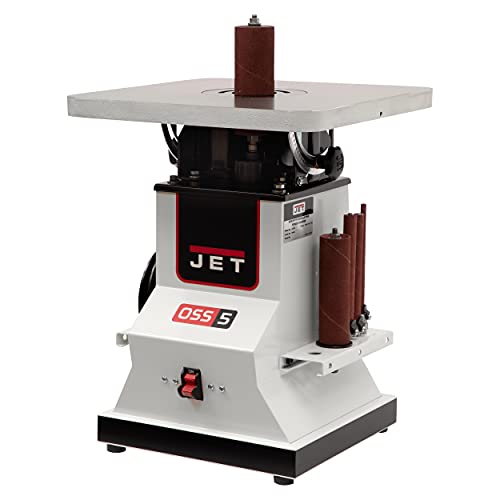 JET Benchtop Oscillating Spindle Sander, 1/2 HP, 115V 1Ph (Model JBOS-5)Check Amazon offer
Side-by-side buying comparison
| Model | Family | Sleeve height (in) | Diameters (in) | Belt size | Table tilt | Offer |
|---|---|---|---|---|---|---|
| WEN 6510T | spindle | Not confirmed | 0.5, 0.75, 1, 1.5, 2, 3 | None documented | 0° | Check Amazon offer |
| Grizzly G0739 | spindle | 4.5 | 0.5, 0.75, 1, 1.5, 2, 3 | None documented | 0° | No exact offer matched |
| WEN AT6535 | spindle | Not confirmed | 0.5, 0.75, 1, 1.5, 2 | None documented | 45° | Check Amazon offer |
| WEN 6524 | combo | 4.5 | 0.5, 0.75, 1, 1.5, 2 | 4 x 24 in. | 45° | Check Amazon offer |
| RIKON 50-300 | spindle | 4.5 | 0.5, 0.75, 1, 1.5, 2 | None documented | 45° | Check Amazon offer |
| JET JBOS-5 | spindle | Not confirmed | 0.25, 0.5, 0.625, 1.5, 2 | None documented | 45° | Check Amazon offer |
Check the model guides for regional variations and source qualifications. Table dimensions do not establish performance or material suitability.
Use six elimination gates before comparing conveniences
Gather three representative parts or full-size drawings: the tightest inside curve, the largest component, and a beveled edge if you make one. The curve sets the largest sleeve diameter that can reach it, while the part size exposes table and surrounding-support needs. Decide whether the edge must stay square, follow a bevel, or alternate with straight sanding. These requirements eliminate unsuitable machine families more reliably than comparing electrical input or horsepower labels.
Next, inspect the exact abrasive system. Sleeve diameter, abrasive height, rubber drum, washer, spindle assembly and throat insert are separate fit questions. A diameter match alone is not compatibility evidence, and rubber-drum height must not be copied into an unknown sleeve-height field. Finish with dust-port mating dimensions, accessory storage, service access and the installed footprint.
- Tightest inside radius and a documented usable sleeve diameter
- Workpiece size, table support and clear feed path around the machine
- Square edge, tilted-table bevel or straight-edge belt requirement
- Exact sleeve diameter and height, drum, washer, assembly and insert
- Dust-port mating measurement, hose route and cleanup plan
- Complete setup cost and a stable bench, stand or floor location
Choose a fixed-table spindle machine for square curved edges
The WEN 6510T is the compact fixed-table candidate with a matching Amazon listing. WEN currently lists six diameters from 1/2 through 3 inches and 2,000 RPM. Its product prose says 30 pounds while the retained manual says 35, and the manual's 3-5/8-inch maximum workpiece height is not sanding-sleeve height. Choose it when square curved edges and the six listed diameters match the project; stop when beveling is required or the weight conflict affects a mobile setup.
The Grizzly G0739 is another fixed-table option, with specifications available from the manufacturer. Grizzly documents six diameters from 1/2 through 3 inches, a 4-1/2-inch drum/abrasive format, 2,000 RPM, a 1-1/2-inch dust port and 30-pound machine weight. That 4-1/2-inch figure does not approve a workpiece height or prove another brand's sleeve assembly will fit. No matching Amazon listing is available, so a similar listing is not substituted.
Choose a tilting-table machine for a named bevel job
The WEN AT6535 exact offer is the lighter tilting-table choice in this shortlist. WEN lists a 14-1/2-inch-square table that moves from 0 to 45 degrees, five sleeve diameters from 1/2 through 2 inches and 2,000 RPM. The product page describes a 1-1/2-inch dust port while the retained manual gives 2-inch outside and 1-7/8-inch inside dimensions; measure the actual outlet and hose rather than smoothing over that conflict.
RIKON 50-300 and JET JBOS-5 are heavier exact-offer candidates when a substantial tilting table and dedicated station fit the shop. RIKON documents a 14-3/4-inch-square table, 0-to-45-degree forward tilt, five included 1/2- through 2-inch spindles, 4-1/2-inch abrasives, an optional 3-inch assembly and 76-pound net weight. JET lists a 14-1/2-inch-square 0-to-45-degree table and 75.6-pound net weight, but its included diameters use mixed sleeve lengths and its 3-inch assembly is optional. Do not treat one advertised sleeve height as applying to every JBOS-5 spindle.
Choose a belt/spindle combination only when both jobs recur
The WEN 6524 exact offer combines five spindle diameters from 1/2 through 2 inches with a 4-by-24-inch sanding belt. WEN lists 2,000 RPM spindle speed, up to 1,575 FPM belt speed and a table that bevels to 45 degrees. It is the relevant format when the same project batch repeatedly alternates between inside curves and straight edges and one footprint is genuinely useful.
Stop if another machine already handles straight edges, if the required inside curve needs the 3-inch option found on some spindle-only machines, or if attachment changeover would interrupt the batch. A combination machine is not automatically more capable: its belt and spindle modes have different abrasives, support arrangements and changeover steps that should be checked in the exact manual.
Compare the whole sleeve system, not the diameter label
A broad diameter range matters only when those sizes serve the actual curves and replacement abrasives are obtainable. Record diameter and abrasive height separately, then identify the rubber drum, spindle assembly, washer and throat insert used at each size. The JET JBOS-5 is a useful warning against one-number assumptions: its narrow and larger included spindles use different sleeve lengths, and the 3-inch assembly is optional.
Use the sleeve Finder to retrieve documented dimensions, not to certify fit. Nominal inch and metric labels may not be exact equivalents, and a listing that matches diameter and length can still have the wrong thickness, backing, drum or hardware. Choose the first grit for a known material-removal step and plan later grit changes around the required finish rather than buying a large mixed pack by advertised piece count.
Apply a stop rule to every shortlisted model
WEN 6510T: stop when a bevel is required or the 30-versus-35-pound documentation conflict changes the setup. Grizzly G0739: stop when an exact Amazon offer or a tilting table is required. WEN AT6535: stop when a 3-inch spindle is necessary or the actual dust connection has not been measured. WEN 6524: stop when the belt mode does not recur or its 2-inch maximum listed spindle size misses the curve.
RIKON 50-300: stop when a 76-pound dedicated station is impractical, or when the optional 3-inch assembly is being mistaken for an included size. JET JBOS-5: stop when mixed sleeve lengths, the optional 3-inch assembly or webpage/manual revision differences remain unresolved. A candidate that triggers a required stop rule leaves the shortlist even if it has more features or a lower current quote.
Price and place the complete sanding station
Add the current machine quote, task-specific sleeves and grits, exact dust adapter or hose, stable bench or stand, and work support. Check how the hose exits, whether a tilting table remains clear and where loose washers and inserts will be stored. The 30-pound compact class and the roughly 76-pound tilting-table class create different movement and support decisions even when both are called benchtop machines.
Before ordering, read the assembly, insert-selection, table-adjustment and operating sections of the exact manual. Keep final hand sanding in the workflow: a spindle sander refines curves and geometry but does not guarantee a finish-ready surface. Choose the simplest surviving format that solves a named recurring job and fits the complete station.
Questions about Best Spindle Sander: Choose by the Work You Do
Which spindle sander is best for most home shops?
There is no measured overall winner here. Start with a fixed-table spindle machine for square curved edges, choose a tilting table for named bevel work, or choose a belt/spindle combination only when straight and curved edge sanding both recur.
Do I need a tilting table on a spindle sander?
Only when a real project requires a beveled curved edge and the workpiece can be supported through the tilt range. A fixed table is the simpler choice for square edges and avoids paying for an adjustment you will not use.
Is a belt and spindle combination always better?
No. It earns its footprint when the same workflow repeatedly needs both straight-edge belt sanding and inside-curve spindle sanding. A spindle-only machine can be simpler when another tool already handles straight edges.
Does a larger motor guarantee better sanding?
No. Sleeve condition, diameter, abrasive grit, work support, feed technique, and the machine design all matter. Published electrical ratings alone are not comparative performance tests.
Should I buy a spindle sander before a random orbital sander?
If your immediate work is broad flat surfaces, address that need first. A spindle sander becomes especially useful when inside curves and shaped edges repeatedly consume your hand-sanding time.
Does matching sleeve diameter prove that a replacement fits?
No. Verify abrasive height, rubber drum, spindle assembly, washer, throat insert, backing and exact machine instructions separately. A diameter match alone is not compatibility evidence.
What if a shortlisted spindle sander has no exact Amazon offer?
Use the manufacturer-backed model guide to evaluate the machine, then verify an exact seller listing separately. Do not substitute another model or bundle merely to create a purchase link.