models
WEN 6510T Spindle Sander Guide
The WEN 6510T suits square-edge curves that can rest flat on a table, with six supplied sleeve diameters reaching 3 inches. Within WEN's sanding family, that larger drum and the fixed-table, spindle-only layout distinguish it from the beveling AT6535, belt-equipped 6524 and portable HA5932. The specifications and buying guidance below are drawn from WEN documentation.
As an Amazon Associate I earn from qualifying purchases. How affiliate links work.
The linked Amazon listing is matched to WEN 6510T. Confirm the full model and package against WEN documentation; the link does not resolve the documented 30-versus-35-pound weight conflict or certify sleeves, drums, washers or inserts.
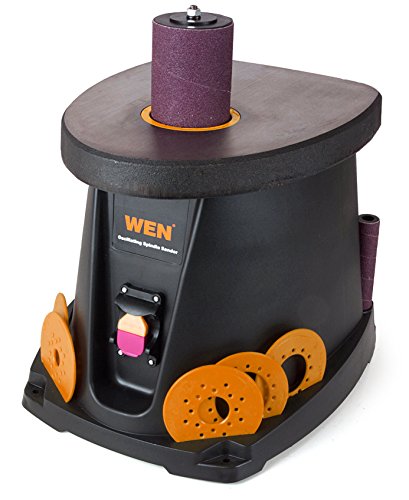 WEN 6510T 3.5 Amp Oscillating Spindle Sander,BlackCheck Amazon offer
Documented specifications for WEN 6510T
| Model | Family | Sleeve height (in) | Diameters (in) | Belt size | Table tilt | Offer |
|---|---|---|---|---|---|---|
| WEN 6510T | spindle | Not confirmed | 0.5, 0.75, 1, 1.5, 2, 3 | None documented | 0° | Check Amazon offer |
- Machine weight
- Not confirmed lb
- Documented spindle speed
- 2000 RPM
- Dust port
- Not confirmed in
Manual lists 35 lb; product prose lists 30 lb. Confirm actual unit.
Maximum workpiece height is 3-5/8 in.; this is not sleeve height.
US 120V documentation.
Where the six-diameter assortment helps
WEN lists sleeve diameters of 1/2, 3/4, 1, 1-1/2, 2, and 3 inches. The published spindle speed is 2000 RPM, with 58 oscillations per minute. Those numbers describe motion; they do not establish how quickly a particular hardwood will sand. The linked manual covers both 6510 and 6510T and gives a maximum workpiece height of 3-5/8 inches. Treat that workpiece limit separately from replacement sleeve length. A tall-looking sleeve does not mean its full height remains available above the table throughout the oscillation. Plan thick work against the stated capacity before choosing this machine.
Choosing a drum for a shaped blank
For a shelf bracket or bandsawn handle, first look at the tightest concave section of the outline. A drum must enter that section without forcing you to change the intended shape. Then consider the longer, gentler curves: a larger contact radius can make it easier to avoid localized hollows. This is a geometric advantage of drum choice, not evidence that one diameter removes material more accurately. Pencil the target line clearly and leave enough material after sawing for controlled cleanup. If the outline alternates tight and broad curves, accepting a diameter change is usually preferable to trying to make the smallest sleeve do every part.
A fixed-table workflow favors square edges
The 6510T makes most sense when the workpiece can remain supported flat while its edge passes the abrasive. Examples include templates, curved rails, and decorative cutouts that need square edges for later assembly. Establishing a reliable flat face on the blank comes before sanding: a warped part can rock even on a sound table. Check the finished edge with a square and inspect the curve with light behind a template where appropriate. The sander does not supply a positive pattern-following mechanism. Hand pressure, support, and the ability to see the line remain central to the result, especially near the ends of a curve.
Buy sleeves as a complete fit specification
Keep the machine model, sleeve height, diameter, backing construction, and supplier fit statement together when ordering. WEN names its 6510-series replacement sleeve packs in the operator manual, which is a stronger starting point than a marketplace listing that says only universal. A matching outside diameter cannot establish correct fit on the drum. Count the throat plates and washers before buying a used example; missing small pieces can prevent a useful drum size from being assembled as intended. Store each size with its associated setup parts so that an abrasive change does not turn into a search through loose hardware.
Make bench placement part of the decision
A compact footprint does not describe the clearance required by a long workpiece. Lay out the largest bracket or template on the proposed bench and trace its movement around the spindle with the power disconnected. Include space for the dust hose and access to the switch. A hose that pulls sideways or catches a blank is a workflow problem even if its fitting matches the port. The manufacturer manual lists 35 pounds, while WEN product copy has described the tool as 30 pounds; allow for that disagreement when planning storage and confirm the actual unit before designing a lifting or folding arrangement. Read the manual before setup and operation.
Judge the curve before judging the surface
For a 6510T project involving paired brackets, stand the two outlines together between sanding stages. Differences are easier to see in silhouette than by running a fingertip over a freshly abraded edge. Preserve the intended symmetry first, then refine scratch depth. The smallest remaining saw mark is not always worth removing if doing so would noticeably alter the profile.
When the 6510T fits better than other WEN formats
The 6510T fits projects whose edges stay square to a stable support face, the six supplied diameters through 3 inches cover the intended curves, and a separate belt station is unnecessary. Stop and compare the AT6535 if beveled contours are recurring work, the 6524 if a 4-by-24-inch belt is part of the same station plan, or the HA5932 if the workpiece cannot be brought comfortably to a benchtop table. Those alternatives solve different support and access problems; they are not performance tiers.
The linked Amazon listing is matched to the full 6510T model name. Before ordering, compare the seller's exact model label and package contents with WEN's current product page and the 6510/6510T manual. The offer does not establish today's price, stock, included revision, replacement-sleeve fit, or the actual unit weight where WEN's page and manual differ.
Questions about WEN 6510T Spindle Sander Guide
Does the 6510T include a 3-inch sleeve?
Yes. WEN lists a six-size sleeve assortment that includes 3 inches. It is a distinguishing feature compared with WEN models whose listed range stops at 2 inches.
Is sleeve length the same as sanding capacity?
No. Sleeve length describes the abrasive consumable. Maximum supported workpiece height is a separate machine limit, and the linked manual specifies 3-5/8 inches for this model family.
Should I choose this or a belt combination?
Choose by the shapes you make. If broad straight edges occupy much of your work, a belt combination deserves comparison. For mostly supported concave profiles, the dedicated spindle layout is the more directly relevant feature.