models
WEN 6524 Spindle Sander Guide
Straight edges and concave contours can share one compact station on the WEN 6524. Its 4-by-24-inch belt, five spindle diameters through 2 inches and table adjustment to 45 degrees suit work that uses both sanding modes. If belt changeovers would add work without serving a recurring task, compare the dedicated 6510T or AT6535. This guide uses WEN's published specifications and setup instructions.
As an Amazon Associate I earn from qualifying purchases. How affiliate links work.
The linked Amazon listing is matched to WEN 6524. Confirm the exact combo model and complete belt/spindle package; belt FPM, sanding-spindle RPM and motor RPM are different quantities and do not prove comparative performance.
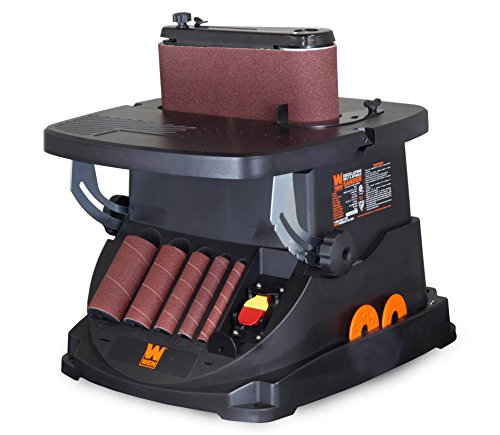 WEN 6524 Oscillating Belt and Spindle SanderCheck Amazon offer
Documented specifications for WEN 6524
| Model | Family | Sleeve height (in) | Diameters (in) | Belt size | Table tilt | Offer |
|---|---|---|---|---|---|---|
| WEN 6524 | combo | 4.5 | 0.5, 0.75, 1, 1.5, 2 | 4 x 24 in. | 45° | Check Amazon offer |
- Machine weight
- 27 lb
- Documented spindle speed
- 2000 RPM
- Dust port
- 1.5 in
Motor RPM in manual is 11,500; sanding spindle speed is 2000 RPM.
All five sleeves are 4-1/2 in. high; the 1/2 in. sleeve mounts directly on the spindle while the four larger sizes use rubber drums.
Manual documents 58 oscillations/min., 5/8 in. stroke and a 1-1/2 in. dust port.
US 120V documentation.
One station for two different contact shapes
The documented belt size is 4 by 24 inches, and the five 4-1/2-inch-high sleeves have nominal diameters of 1/2, 3/4, 1, 1-1/2, and 2 inches. The four larger sizes use rubber drums; the 1/2-inch sleeve fits directly on the spindle. WEN lists a 1575-feet-per-minute belt speed and 2000-RPM sanding-spindle speed, with 58 oscillations per minute and a 5/8-inch stroke. The manual's 11,500-RPM figure is motor speed, not a second sanding-spindle setting.
Batch operations to make conversion worthwhile
Imagine a group of decorative brackets with straight mounting faces and a curved underside. You could complete the straight-edge work on all blanks, disconnect the machine, convert it according to the manual, and then address their concave sections. That order avoids switching attachments for every piece. It also gives you a chance to compare matching components at the same stage, while there is still material left for corrections. For a one-off part the advantage is space, not necessarily speed. A dedicated belt machine and dedicated spindle can remain independently ready, so a combo should be assessed against your available bench space and real changeover frequency.
A belt does not replace a reference-making machine
A hand-fed sanding belt can clean a sawn edge, but it does not automatically establish the straightness or squareness expected from a properly prepared jointing operation. Mark the intended edge, maintain support, and inspect progress using a suitable straightedge and square. Do not erase the reference line simply because the surface already looks smooth. At transitions between straight and curved sections, sanding too long in one place can change the silhouette. Stop and compare adjoining areas as a whole. The most useful role for this machine is controlled refinement after reasonable stock preparation, rather than correcting large errors by prolonged abrasive removal.
Separate the two abrasive inventories
A combination machine needs both belts and sleeves, which means grit planning becomes a little more involved. Record belt width and loop length together; record sleeve diameter and height separately. A supplier offering one compatible belt size has not thereby established that its sleeves fit. Keep fresh shaping and finishing abrasives organized by mode, and inspect their condition before starting a batch. If one stage leaves unusually deep scratches, check the abrasive and technique before moving to a finer grit. Budgeting only for the machine overlooks the consumables needed to make both functions useful across different projects and wood species.
Allow room around the tilting table
WEN states a zero-to-45-degree table range and a 1-1/2-inch dust port. Its manual lists a 27-pound net weight. For bench planning, use the manufacturer dimensions and add the swept path of the longest piece you will sand. Include access for changing the belt assembly, storing unused drums, and reaching the dust connection. A crowded corner may fit the base but still force awkward feeding positions. If the machine lives on a removable board, assess the stability of the complete board-and-bench arrangement. Follow the manual for mounting, attachment changes, and tracking adjustments, with the machine disconnected whenever you perform those setup operations.
Check the transition between sanding modes
After using both modes on a 6524 project, examine the junction between the belt-refined edge and the spindle-refined curve under raking light. The two regions can look individually smooth while meeting with an unintended flat or shoulder. Leave enough material at that junction for a final controlled blend and check the outline against the original drawing before removing more.
Does your work justify belt-to-spindle changeovers?
The 6524 is useful when a 4-by-24-inch belt and spindle sizes through 2 inches are both used often enough to justify conversion and two abrasive inventories. Stop and compare the 6510T when a dedicated fixed-table station and included 3-inch drum fit better, the AT6535 when beveled curved work matters without a belt, or the HA5932 when bringing the tool to secured work is the actual access solution. A combo's feature count does not make it a universal upgrade.
The linked Amazon listing is matched to WEN 6524, but the seller's package still needs to be checked for the belt assembly, five throat plates, four rubber drums, model-specific washers and six listed abrasive pieces. The manual's written warranty differs for home and professional use, excludes wear accessories such as belts, and requires dust collection during operation. Read the current terms for the actual purchase rather than transferring coverage from another WEN product or a secondhand listing.
Questions about WEN 6524 Spindle Sander Guide
Is the WEN 6524 variable speed?
WEN publishes the operating belt and spindle speeds but does not advertise user-adjustable variable speed on this model. Do not treat wording such as up to 2000 RPM as proof of a speed control.
Can it sand both straight and curved edges?
Its belt and spindle modes provide different contact shapes for those tasks. The suitability of a particular part still depends on support, access, intended geometry, and the operator following the manual.
Does a 4 x 24-inch belt establish sleeve compatibility?
No. Belt dimensions and spindle sleeve dimensions are unrelated consumable specifications. Confirm sleeve height, diameter, construction, and a model-specific fit statement independently before ordering replacements.