models
RIDGID EB4424 Spindle Sander Guide
The RIDGID EB4424 combines an oscillating belt with interchangeable spindle sanding components. It is a distinct model family from the R4840, even when listings use very similar product names. Use the EB4424 documentation below to check the belt and spindle package, table adjustment and parts present on an offered machine.
As an Amazon Associate I earn from qualifying purchases. How affiliate links work.
No exact EB4424 Amazon offer was matched. The WEN 6524 shown below is a different-brand belt-and-spindle alternative, not this RIDGID or a parts-compatible substitute.
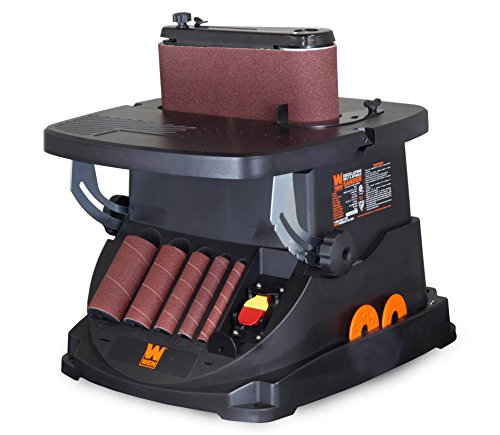 WEN 6524 Oscillating Belt and Spindle SanderCheck Amazon offer
Documented specifications for RIDGID EB4424
| Model | Family | Sleeve height (in) | Diameters (in) | Belt size | Table tilt | Offer |
|---|---|---|---|---|---|---|
| RIDGID EB4424 | combo | 4.5 | 0.5, 0.75, 1, 1.5, 2 | 4 x 24 in. | 48° | No exact offer matched |
- Machine weight
- 40 lb
- Documented spindle speed
- 1725 RPM
- Dust port
- 2.5 in
EB4424 manufacturer page and linked EB44241 manual; confirm the exact suffix/revision on used machines.
All five sleeves are 4-1/2 in. high; the 1/2 in. sleeve mounts directly on the spindle while the four larger sizes use rubber drums.
Manual documents a 2-1/2 in. rear dust port, 60 oscillations/min. and 3/4 in. stroke.
Do not transfer EB4424 parts or service terms to R4840.
Recognize the EB4424 specification set
RIDGID lists a 4-by-24-inch belt, 1725-RPM spindle speed, 1350-feet-per-minute belt speed, and 60 oscillations per minute. The official product page gives a 3/4-inch stroke and a 40-pound weight. Its table range reaches 48 degrees, with familiar detents including 45 degrees. That final few degrees of travel is a documented distinction, but it should matter only if your work needs it. A specification sheet cannot tell you whether a used table locks securely, whether a belt tracks correctly, or whether a particular blank remains well supported at the desired angle. Those are separate inspection questions.
Inventory the conversion parts before buying used
An assembled belt attachment can make an incomplete machine look ready for every task. The EB4424 manual lists five 4-1/2-inch-high sleeves from 1/2 through 2 inches, four rubber drums for the 3/4-through-2-inch sleeves, three upper washers, spacer-ring throat plates, a table insert and the belt assembly. The 1/2-inch sleeve mounts directly on the spindle rather than on its own rubber drum. Compare every loose part with the exact manual diagram; shared nominal sleeve diameters with WEN 6524 do not establish interchangeable drums, washers or throat plates.
Treat the tilting front support as a reference
A beveling table is valuable when it supports a component in a repeatable orientation. Make a setup piece with the same reference face and thickness as the project, then check the resulting bevel. On shaped parts, label the reference face so successive pieces do not get presented in mirrored orientations unintentionally. Use the detents as starting positions and verify what the abrasive actually produces. Wear, accumulated debris, and an incorrectly established zero reference can affect the relationship between the scale and the finished edge. Inspect the entire supported path of a broad part, not just the region immediately alongside the sanding surface.
Separate surface refinement from dimensional correction
The EB4424 can offer convenient access to a straight belt region and to internal curves, but freehand sanding remains a material-removal process without a built-in pattern follower. If you are making matching furniture brackets, compare the outlines frequently and preserve the marking line until the final controlled passes. A smooth surface can still have an unwanted hollow. When the piece needs a reliably straight joining edge, establish that geometry using an appropriate preparation method before final cleanup. For repeated shapes, decide in advance which faces are dimensional references and which edges are primarily cosmetic; that distinction tells you where small deviations matter most.
Keep support and warranty records model-specific
RIDGID’s current EB4424 page links standard 3-year limited terms and advertises a potential Lifetime Service Agreement. The longer program is not automatic: the written terms tie it to an eligible original Home Depot purchase, registration and proof submitted within 90 days, and approval. It begins after the standard period and is not transferable. The R4840 has separate stationary-tool documentation, so verify the exact model, transaction and applicable written terms before relying on coverage.
Assess a used table with project-sized references
When inspecting an EB4424, bring a small straightedge and an outline representative of your work rather than judging only by photographs. With permission and power disconnected, examine how the support accommodates the shape. This is an inspection planning suggestion, not a substitute for a safe operational demonstration or a service assessment of the internal mechanism and electrical condition.
Questions about RIDGID EB4424 Spindle Sander Guide
Does the EB4424 table stop at 45 degrees?
RIDGID’s official page specifies a zero-to-48-degree range, with a detent at 45 degrees among the listed positions. Verify the actual setup and follow the manual for adjustments.
Is EB4424 the same machine as R4840?
No. They are separately identified models with different support documentation. Similar belt dimensions and branding do not establish interchangeable mechanisms, hardware, or warranty terms.
What makes a used example complete?
Completeness requires checking both sanding modes against the exact parts list. A working belt configuration alone cannot establish that every drum, plate, washer, and conversion component is present.