models
RIDGID R4840 Spindle Sander Guide
The RIDGID R4840 is a separately identified oscillating belt-and-spindle sander, not simply another spelling of EB4424. Its identity is confirmed by RIDGID’s stationary-tool service documentation and the dedicated retail listing, but an equally complete model-specific technical manual was not accessible. This guide leaves unresolved operating specifications blank rather than importing figures from EB4424.
As an Amazon Associate I earn from qualifying purchases. How affiliate links work.
No exact R4840 Amazon offer was matched. The WEN 6524 shown below is a different-brand belt-and-spindle alternative, not this RIDGID or a parts-compatible substitute.
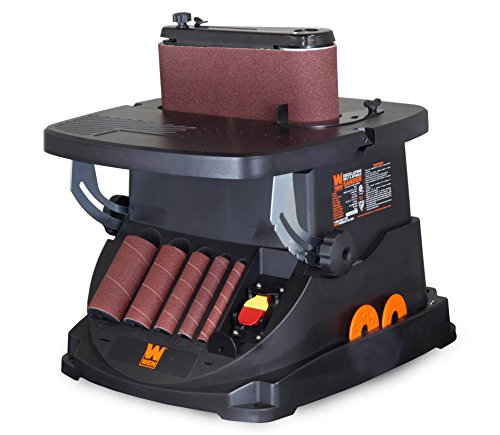 WEN 6524 Oscillating Belt and Spindle SanderCheck Amazon offer
Documented specifications for RIDGID R4840
| Model | Family | Sleeve height (in) | Diameters (in) | Belt size | Table tilt | Offer |
|---|---|---|---|---|---|---|
| RIDGID R4840 | combo | Not confirmed | Not confirmed | 4 x 24 in. | Not confirmed | No exact offer matched |
- Machine weight
- Not confirmed lb
- Documented spindle speed
- Not confirmed RPM
- Dust port
- Not confirmed in
R4840 identity and 4 x 24 in. belt are supported by the dedicated retailer record; RIDGID's stationary-tool terms separately name the model.
An accessible manufacturer technical page/manual did not resolve; all other technical fields remain null or empty.
Do not borrow EB4424 specifications or service agreement.
Start with the nameplate, not the orange housing
The R4840 listing describes a combination machine with a 4-by-24-inch oscillating belt and a spindle conversion. That common belt format explains why search results often place it beside other compact combinations, but it does not establish that their mechanisms are the same. Ask for a clear photograph of the model and serial label when evaluating a used unit. Match the model to the operator manual and parts drawing before selecting abrasives or repair items. Search phrases such as RIDGID spindle sander are useful for discovery but too broad for an order involving a table insert, drive component, or conversion assembly.
Avoid building a comparison from mixed specifications
A seemingly detailed comparison can be less useful than a short one when the figures come from different models. EB4424 speed, table travel, and accessory hardware should not silently populate an R4840 specification column. The comparison data accompanying this guide therefore retains unknown fields until primary model-specific documentation establishes them. This does not mean the R4840 lacks those features; it means the evidence is incomplete. When asking a seller or support representative for clarification, request the relevant manual page or part number. A screenshot of a generic product description can repeat the same ambiguity that caused the problem in the first place.
Evaluate the complete two-mode package
A combination sander’s practical value depends on the accessories that let you use both contact shapes. Inspect the belt mechanism and gather every supplied spindle-related part before judging completeness. Have the seller identify how the machine converts using the proper manual, rather than accepting a pile of apparently similar components. A missing small insert can be more inconvenient than a worn belt because belts are consumables while inserts are model-specific support parts. For an existing owner, organize the removed attachment and hardware by function. Recording the manufacturer part numbers during a routine inventory makes subsequent support conversations much more precise.
Plan a project sequence that benefits from conversion
Consider a small batch of curved cabinet details. Straight reference faces can be prepared first, followed by contour refinement after the machine is configured for a spindle. The benefit is a shared station and a consistent place for extraction and accessories. If every component repeatedly alternates between belt work and several spindle diameters, count those changes realistically. Two dedicated machines may offer a different workflow even when their total footprint is larger. This is an editorial way to assess a combination design, not a claim that the R4840 converts faster than competitors or saves a measured number of minutes in production.
Read the specific stationary-tool service terms
RIDGID’s separate stationary-tool terms explicitly name R4840 and describe five-year coverage for qualifying tools purchased on or after February 1, 2021. The terms identify the original retail purchaser, require the original dated receipt and say the coverage is nontransferable; sandpaper and other consumables are excluded. Check the current written terms and the designated service route for the actual transaction. For shop fit, measure the real machine or obtain an R4840-specific drawing rather than importing EB4424 dimensions.
Keep a clean purchasing evidence trail
For an R4840 transaction, save the seller’s accessory photographs alongside the model-label photo and the promised contents. This creates a concrete reference if a conversion piece is missing at collection. It also helps a support representative distinguish the actual machine from a generic description. Resolve essential missing documentation before designing permanent shop furniture around an assumed set of dimensions.
Questions about RIDGID R4840 Spindle Sander Guide
Why are some R4840 specifications blank here?
Those fields were not established from accessible model-specific primary documentation during research. Leaving them unknown prevents specifications from EB4424 or another combination sander being presented as R4840 facts.
Does R4840 use the EB4424 service agreement?
Do not assume that. RIDGID explicitly includes R4840 in separate stationary-tool five-year service terms. Check those terms and your purchase details directly with the designated support provider.
Can I use any 4 x 24-inch belt?
The listed loop dimensions identify the basic format. You still need a suitable abrasive construction, speed suitability, and manufacturer guidance. Shared belt dimensions do not establish compatibility of spindle accessories or internal parts.