models
Grizzly T27417 Spindle Sander Guide
Choose the Grizzly T27417 when recurring straight-edge and inside-curve work justifies one 4 × 24-inch belt-and-spindle station and its changeovers. Stop when a 3-inch spindle, a dedicated always-ready mode or documented variable-speed control is required. Grizzly documents the supplied assemblies and table detents, but its zero-to-2000-RPM wording does not establish an adjustable speed dial.
As an Amazon Associate I earn from qualifying purchases. How affiliate links work.
No exact Amazon offer was matched for this model. The listings below are alternative machines to investigate, not this model or guaranteed equivalents.
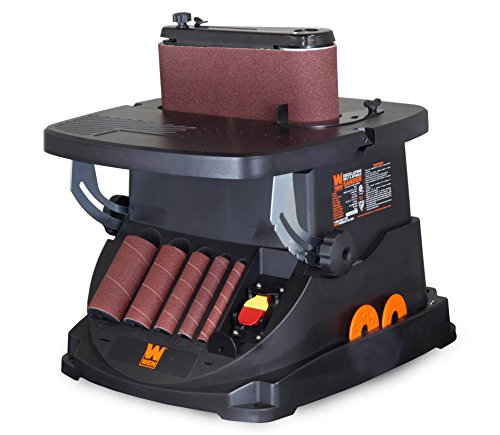 WEN 6524 Oscillating Belt and Spindle SanderCheck Amazon offer
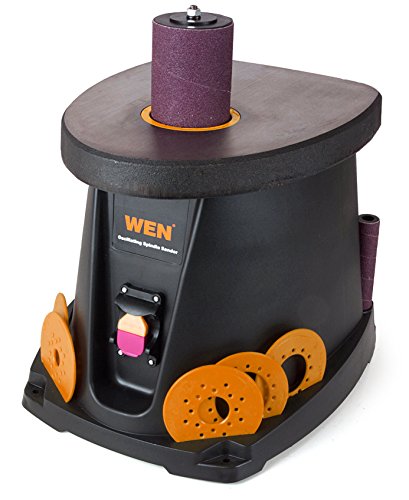 WEN 6510T 3.5 Amp Oscillating Spindle Sander,BlackCheck Amazon offer
Documented specifications for Grizzly T27417
| Model | Family | Sleeve height (in) | Diameters (in) | Belt size | Table tilt | Offer |
|---|---|---|---|---|---|---|
| Grizzly T27417 | combo | 4.5 | 0.5, 0.75, 1, 1.5, 2 | 4 x 24 in. | 45° | No exact offer matched |
- Machine weight
- 27 lb
- Documented spindle speed
- 2000 RPM
- Dust port
- 1.5 in
Manual applies to machines manufactured since September 2015.
Manual prints spindle speed 0–2000 RPM; no variable-speed control inferred.
Five sleeves but four rubber drums: the 1/2 in. sleeve mounts directly to the spindle.
Table detents documented at 0, 15, 22.5, 30 and 45 degrees.
US 120V documentation.
The combination has a defined size envelope
Grizzly documents a 4-by-24-inch 80-grit belt, five 4-1/2-inch 80-grit sleeves from 1/2 through 2 inches and four rubber drums because the smallest sleeve mounts directly to the spindle. The cast-aluminum table tilts from 0 to 45 degrees with listed detents at 0, 15, 22.5, 30 and 45 degrees. The package includes the edge-sanding attachment, five throat plates, table insert, washers and wrench. This is a compact combination category, not a dedicated spindle machine with an informal belt add-on, and it does not include the 3-inch size found on some dedicated models.
Do not mistake speed wording for a speed dial
The T27417 sheet and manual print spindle speed as zero to 2000 RPM, yet the documented user control is an on/off paddle switch rather than an adjustment dial. The belt speed is 1575 feet per minute, with 58 oscillations per minute and a 5/8-inch stroke. Read these as published motion data, not proof that intermediate spindle speeds can be selected. Buyers who specifically need controlled variable speed should require an explicit manufacturer statement and identified control before choosing this model.
Use changeover as a natural batch boundary
When making repeated parts, sort operations so the belt handles the appropriate edges together and the spindle handles the curved regions afterward. A batch boundary is also a useful inspection point: compare dimensions and outlines before removing further stock. It is easier to identify an outlier while all the pieces are at the same stage. If the job repeatedly jumps between a straight face and several tight curves, conversion may become a noticeable part of the work. That does not make the combination unsuitable, but it means its space advantage should be weighed against the convenience of two machines left ready in different configurations.
Treat tracking and abrasives as ordinary ownership tasks
The manufacturer manual includes separate procedures for changing the belt and checking its tracking. Learn those procedures before the first replacement is needed. A belt that is merely the correct loop size is not automatically ready to run after installation. Inspect the abrasive and follow the prescribed setup checks, with power disconnected for the operations requiring disconnection. Keep sleeves organized separately by diameter and grit, and verify their complete model-specific fit. Bent, crushed, or poorly stored consumables complicate a job before sanding even begins. Provide a dry storage location where belts retain their shape and smaller sleeves do not get lost under unrelated accessories.
Give extraction and maintenance a place in the layout
The T27417 manual specifies a 1-1/2-inch dust port and recommends 100 CFM at that connection. Its listed base dimensions are only part of the needed space. Add hose clearance, the sweep of long workpieces, room to remove the belt assembly, and access to the stored drums. A cabinet that encloses every side tightly can make cleaning and inspection unnecessarily awkward. Before fixing the machine permanently, simulate a conversion and a full pass with the largest intended blank while the machine is disconnected. This helps reveal practical conflicts between storage slots, neighboring equipment, and the operator’s stance that a footprint measurement does not show.
Reserve a place for the removed attachment
In a T27417 workstation, give the unused belt assembly a stable, clearly defined storage position. Consider its full shape when opening cabinet doors or moving the station. The goal is practical access: a conversion becomes inconvenient when the removed component must be balanced among unrelated tools, and its abrasives can be damaged by contact with loose hardware during storage.
Questions about Grizzly T27417 Spindle Sander Guide
Is the T27417 variable speed?
The manual’s zero-to-2000-RPM wording does not by itself establish user-adjustable speed, and this guide does not label it variable speed. Require explicit manufacturer confirmation if that feature is essential.
Does it include a 3-inch spindle size?
The documented assortment stops at 2 inches. Buyers needing a larger drum should compare a machine explicitly listing that size rather than assuming a larger sleeve can be added.
How does it differ from a dedicated spindle?
Its belt mode adds a straight contact region and an additional abrasive inventory. It also introduces conversion and tracking tasks. Whether that is useful depends on the mix and sequence of your woodworking operations.