models
BAUER 191511E-B Spindle Sander Guide
The BAUER 191511E-B is Harbor Freight item 56870, an oscillating edge belt and spindle combination. Keeping both identifiers is useful because parts and manual searches may use the item number while the machine label shows the model. Harbor Freight's product page and manual provide the machine details below, including a small belt-speed discrepancy and the parts needed for each sanding mode.
As an Amazon Associate I earn from qualifying purchases. How affiliate links work.
No exact Amazon offer was matched for this model. The listings below are alternative machines to investigate, not this model or guaranteed equivalents.
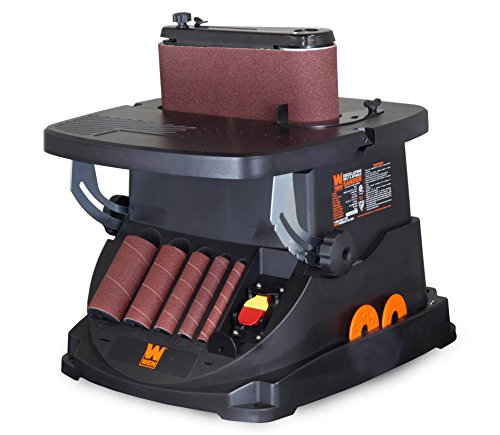 WEN 6524 Oscillating Belt and Spindle SanderCheck Amazon offer
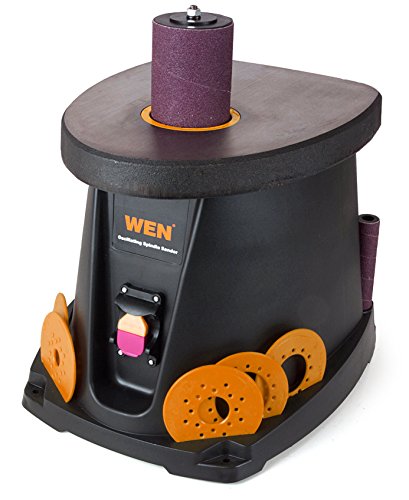 WEN 6510T 3.5 Amp Oscillating Spindle Sander,BlackCheck Amazon offer
Documented specifications for BAUER 191511E-B
| Model | Family | Sleeve height (in) | Diameters (in) | Belt size | Table tilt | Offer |
|---|---|---|---|---|---|---|
| BAUER 191511E-B | combo | Not confirmed | Not confirmed | 4 x 24 in. | 45° | No exact offer matched |
- Machine weight
- 27.88 lb
- Documented spindle speed
- 2000 RPM
- Dust port
- Not confirmed in
Verified model 191511E-B = Harbor Freight SKU 56870.
Product belt speed 1600 FPM; manual 1611 FPM.
Five sleeves documented; full primary diameter/height specification not resolved.
US 120V documentation.
Two identifiers, one documented product
Harbor Freight’s product page explicitly pairs model 191511E-B with SKU 56870. It lists a 3.5-amp motor, 2000-RPM spindle speed, a 4-by-24-inch belt, and a table range to 45 degrees. The listed product weight is 27.88 pounds. Preserve the UPC and manual revision too when ordering support parts, because a product family name is less precise than the full label information. A similar-looking machine sold under another brand is not evidence of interchangeable assemblies. The identifying numbers should lead the parts search; exterior resemblance should play no role in deciding that a drive component or table insert will fit.
Notice the small belt-speed discrepancy
The product page describes 1600 feet per minute for the belt, while the linked manual specifies 1611 feet per minute. This guide reports that as a documentation difference rather than hiding it or attributing a real performance advantage to eleven feet per minute. The machine’s documented spindle speed is consistent at 2000 RPM. For most woodworking purchasing decisions, the more consequential questions are whether the belt contact region suits your straight edges, whether the spindle setup accesses your curves, and whether the station fits your bench. If an exact operating figure matters for an accessory, obtain a current model-specific confirmation instead of choosing between rounded marketing and manual values.
Inspect both attachment systems on an open-box unit
An open-box or used combination may have a belt assembly installed while the spindle parts are scattered or absent. Compare the supplied components with the manual inventory before accepting a claim of completeness. Harbor Freight lists five spindle sleeves and four rubber drums; the smallest sleeve uses the spindle directly according to the manual. That difference in counts is intentional, not automatically a missing drum. Also check the belt-related stop and attachment hardware. Document which pieces are present and request replacement availability for anything missing. A machine that powers on cannot demonstrate that every intended sanding configuration is ready to use.
Let your project decide which mode goes first
For a wooden handle with a flat attachment face and a curved grip outline, establish the reference face before final contour sanding. On a batch, finish one class of operation across the parts before changing the machine configuration. Keep the outline visible and check matching components together. The belt’s straight region can refine an edge, but it does not automatically correct a bowed blank into a precise jointing surface. Similarly, a spindle reaches a concavity without guaranteeing its radius. Both modes reward a well-prepared blank and periodic measurement. The combination saves a separate footprint only when its two forms of contact are actually relevant to your work.
Plan accessories without assuming universal fit
Record the belt’s complete width and loop length, and obtain the sleeve height and diameter from a model-specific replacement listing. The five-sleeve count does not establish every diameter or sleeve height; confirm those unresolved dimensions with Harbor Freight or a model-specific replacement listing. Keep original drums and washers paired with their specified sizes. For dust connection, measure the actual mating surfaces before choosing an adapter; a generic statement about standard dust collectors is not a precise fitting dimension. Include room for the hose, table-angle locks, and belt removal in the bench layout. Follow the manufacturer’s setup and tracking procedures before operation.
Compare the complete station, not only the machine
When weighing the BAUER combination against another sander, list the extraction adapter, initial abrasive selection, support surface, and any missing accessory replacements for each option. That produces a more meaningful comparison than the machine alone. It also reveals whether an apparently compact purchase requires additional storage or a different bench arrangement to use both sanding modes comfortably.
Questions about BAUER 191511E-B Spindle Sander Guide
What Harbor Freight item is BAUER 191511E-B?
The manufacturer-retailer product page identifies it as item 56870. Keep that SKU together with model 191511E-B and the label’s UPC when looking for the correct manual or replacement parts.
Why do belt-speed figures differ?
Harbor Freight’s page lists 1600 FPM and the linked manual lists 1611 FPM. This guide treats those as published-source differences, not as proof of different performance or a separate version.
Are same-looking combination-sander parts interchangeable?
Exterior similarity is insufficient. Confirm the exact part number and manufacturer fit for item 56870, especially for conversion hardware, drums, table inserts, and internal drive components.