brands
RIDGID Spindle Sanders: The Combination-Shop Decision
The useful question behind a RIDGID spindle sander search is whether one combination station fits your workshop. RIDGID documents an oscillating edge belt and spindle sander, so buyers need to consider both configurations and the transition between them. A familiar brand name cannot answer how much room a project needs around the table or how often a belt setup will interrupt curved sanding. Plan the sequence of belt and spindle operations before comparing exact-model reviews and seller offers.
As an Amazon Associate I earn from qualifying purchases. How affiliate links work.
No exact RIDGID machine listing was matched. The WEN 6524 shown below is a different-brand belt-and-spindle alternative, not an EB4424 or R4840 substitute.
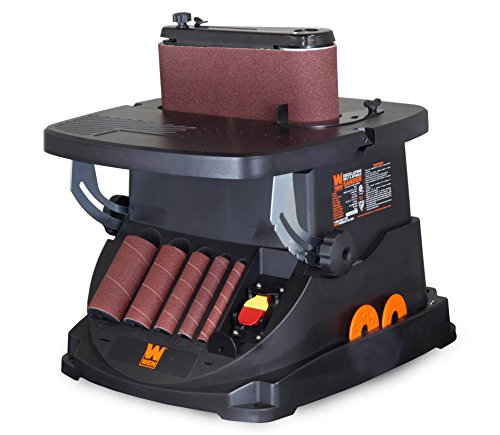 WEN 6524 Oscillating Belt and Spindle SanderCheck Amazon offer
What the documented family offers
RIDGID's current EB4424 page documents a legacy combination platform with a 4-by-24-inch belt, five 4-1/2-inch sleeves and a zero-to-48-degree table. The separately identified R4840 is covered by a different stationary-tool service page and retail record; its missing technical cells cannot be filled from EB4424. Both belong to the belt-and-spindle category, but a family name does not make their conversion hardware, parts or service terms interchangeable.
When combining functions helps
A project that moves repeatedly from straight rails to curved brackets creates a good reason to investigate a combination sander. The same station can serve more than one edge-finishing task, reducing the number of separate machines competing for space. Yet a mixed workload is not automatically a good workflow. If you must interrupt a carefully set bevel or switch configurations for every second component, separate stations may be easier to manage. Group similar operations together when possible. Think through a complete batch of parts, including abrasive changes, before treating conversion convenience as a decisive advantage.
Look beyond the tabletop outline
Measure the space occupied by the workpiece while you guide it, not simply the published footprint. A curved panel can sweep across a much larger arc than the machine itself. The belt configuration introduces its own approach paths and can change where you stand. Leave room for the extraction hose and for removing assemblies without balancing them on another tool. If the sander will live on a cart, assess the cart's stability and working height with the largest intended part. A compact machine on an unsuitable support can be less convenient than a larger dedicated station.
Inspect accessories before a used purchase
Ask the seller to arrange all drums, sleeves, inserts, washers, and the belt assembly in one photograph. Compare that inventory with the parts list for the full model number. Missing loose components can be easy to overlook when the machine is demonstrated in only one configuration. A spinning spindle does not confirm that the belt assembly is complete, and a running belt does not demonstrate that every spindle size can be installed correctly. Obtain a clear photograph of the identification plate, because an older family member should not inherit compatibility claims from a more recent listing.
Read service terms at the source
RIDGID's product material discusses a Lifetime Service Agreement, but a buyer should read the applicable terms for the exact product, purchase channel, and registration situation. Do not treat an old review or a seller's casual phrase as confirmation of your coverage. Save the receipt and the documentation supplied with the tool, and resolve any uncertainty with the service provider before assuming a repair will be covered. For a secondhand purchase, investigate service and replacement parts independently of the machine's original advertising. The practical question is what support applies to your transaction.
Decide on the recurring job
The strongest reason to choose this RIDGID family is a repeated need for its two supported sanding formats in one place. If nearly all your work is small internal curves, a spindle-only machine also deserves consideration. If broad panel faces are the real problem, this combination belongs to the wrong category. Build your shortlist around representative parts, complete accessories, comfortable support, and a clear service path. A feature checklist can confirm that a machine qualifies, but it cannot substitute for understanding how your hands and materials will move through the job.
Questions about RIDGID Spindle Sanders: The Combination-Shop Decision
Is RIDGID just a spindle sander?
The documented EB4424 family combines oscillating edge belt and spindle sanding. Evaluate both configurations and their accessory requirements.
Should I assume a used RIDGID has lifetime coverage?
No. Check the current agreement and the purchase or registration conditions that apply to the particular transaction.
What should a seller photograph?
Request the model plate, table, controls, belt assembly, and all loose spindle accessories so you can compare them with the correct manual.