comparisons
WEN vs RIDGID Spindle Sanders: Compare Exact Models
WEN versus RIDGID is useful only after selecting actual models. WEN sells spindle-only and belt-and-spindle designs, while RIDGID's EB4424 is a documented belt-and-spindle combination. The R4840 is a different RIDGID model and must be researched separately. For a practical starting point, this article compares the WEN 6524 and RIDGID EB4424 as combo candidates, then explains when a spindle-only WEN may be the more relevant alternative.
As an Amazon Associate I earn from qualifying purchases. How affiliate links work.
The retained Amazon offer matches WEN 6524. No exact EB4424 offer was found; the WEN card does not represent the RIDGID side or imply parts compatibility.
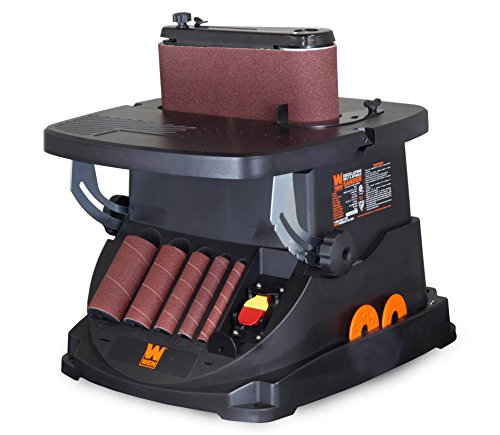 WEN 6524 Oscillating Belt and Spindle SanderCheck Amazon offer
Side-by-side buying comparison
| Model | Family | Sleeve height (in) | Diameters (in) | Belt size | Table tilt | Offer |
|---|---|---|---|---|---|---|
| WEN 6524 | combo | 4.5 | 0.5, 0.75, 1, 1.5, 2 | 4 x 24 in. | 45° | Check Amazon offer |
| RIDGID EB4424 | combo | 4.5 | 0.5, 0.75, 1, 1.5, 2 | 4 x 24 in. | 48° | No exact offer matched |
Check the model guides for regional variations and source qualifications. Table dimensions do not establish performance or material suitability.
Compare the approaches
| Decision | First option | Second option |
|---|---|---|
| Documented sanding motion | 6524: 2,000 RPM spindle, 1,575 FPM belt, 58 oscillations/minute and 5/8-inch stroke | EB4424: 1,725 RPM spindle, 1,350 FPM belt, 60 oscillations/minute and 3/4-inch stroke |
| Included sanding formats | 4 x 24-inch belt; sleeves at 1/2, 3/4, 1, 1-1/2 and 2 inches | 4 x 24-inch belt; the same five sleeve diameters, with four rubber drums for the larger sizes |
| Table range | WEN documents 0–45 degrees | RIDGID documents 0–48 degrees with detents at 0, 15, 22.5, 30 and 45 degrees |
| Listed installation facts | 27-pound net weight and 1-1/2-inch dust port in the WEN manual | 40-pound tool weight and 2-1/2-inch rear dust port in the RIDGID manual |
| Offer evidence | Exact retained 6524 Amazon match with model photo | No exact EB4424 Amazon match in the retained catalog; alternatives are not equivalent offers |
| Stop rule | Stop if a dedicated spindle station would avoid an unused belt mode | Stop if the exact EB4424 identity, complete conversion hardware or applicable support terms cannot be verified |
Make the comparison like for like
The WEN 6524 and RIDGID EB4424 each offer belt and spindle functions, so they answer a similar broad workshop need. Comparing an EB4424 against a spindle-only WEN 6510T instead introduces a feature decision before the brand decision. Neither comparison is wrong, but it should be explicit. Ask whether straight-edge sanding belongs in your required workflow. If it does, compare combos. If it does not, a dedicated spindle machine should remain on the shortlist regardless of the logo on its housing.
Use documented differences without inventing results
WEN lists a table adjustment to 45 degrees for the 6524. RIDGID lists a 0-to-48-degree range with detents for the EB4424. Those facts may matter if your intended angle or preferred setup method uses them. They do not prove that either table is more accurate, rigid, or comfortable. Check how the relevant portion of the table supports your stock through the pass. A feature has practical value when it solves a real setup, rather than simply producing a larger number in the comparison.
Keep the two RIDGID identities separate
RIDGID's manufacturer page identifies the EB4424 in its ordering information. Home Depot identifies R4840 on its separate product listing. Specifications from the EB4424 should not be copied into an R4840 comparison, even if a search result uses the same general product name. The distinction is particularly important with used listings and older reviews. Ask for the model label, then match the manual, accessories, and service information. A brand-level buying discussion cannot erase model-specific differences in hardware or documentation.
Examine the actual sequence of mode changes
Both shortlisted combos require a correctly assembled transition between belt and spindle work. Read each procedure and identify the pieces that must be removed, fitted, stored, or tightened. Imagine doing that with the machine in its final bench position, including the hose and nearby tools. If most of your work can be batched, changeover may have modest importance. If you constantly fit individual parts using both sanding surfaces, the arrangement and accessibility of those changes deserve more weight than a minor difference in published speed.
Compare ownership questions with the same rigor
Check current manufacturer terms, eligibility, purchase documentation requirements, and available service routes for the exact offer. Do not reduce the comparison to a slogan about a warranty or lifetime service, because conditions and qualifying models matter. Record replacement sleeve sizes and locate model-specific inserts and fastening parts. Price the full setup with any adapters or additional grits. These practical ownership questions can distinguish two otherwise suitable purchases without pretending to know which motor will outlast the other.
Choose by the requirement that separates the candidates
If you need a particular approved table angle or prefer an available setup arrangement, let that verified difference guide the choice. If both machines meet all requirements, compare current complete cost and the support route you can realistically use. If the belt function is unnecessary, revisit WEN's spindle-only options and other dedicated models instead of forcing a brand contest between combos. This is a suitability comparison built from manufacturer information; no controlled sanding, noise, vibration, or durability test has been performed for this article.
Make a comparison row for each required feature: curve access, supported height, angle, mounting space and available consumables. Confirm each row from the exact model's documentation. When both combos pass, current complete cost and accessible service can settle the choice. If a listing mixes RIDGID model numbers, leave its affected rows unresolved until the seller establishes the identity; advertised specifications and protection programs need to belong to the machine supplied.
Questions about WEN vs RIDGID Spindle Sanders: Compare Exact Models
Is WEN or RIDGID the better spindle-sander brand?
There is no evidence here for a universal brand winner. Compare exact models that offer the functions, approved capacity, and support arrangement your projects require.
Are RIDGID EB4424 and R4840 the same model?
No. They have different model identifiers and documentation. Use the manual and specifications for the machine actually offered rather than transferring EB4424 details to an R4840 listing.
Which WEN should I compare with a RIDGID combo?
The WEN 6524 is a relevant belt-and-spindle starting point. A spindle-only WEN comparison is also useful if you are deciding whether the extra belt function is necessary.