buying guides
Belt and Spindle Combo Sanders: What to Compare
Choose a belt-and-spindle combo when the same projects repeatedly need a supported belt for suitable straight or outside edges and a sleeve for concave edges—and when those operations can be batched. Choose a dedicated spindle station when inside curves dominate, another tool already handles straight-edge work, or keeping a drum setup ready matters more than sharing one footprint. The decision turns on belt size, support in each mode, changeover frequency and the parts you actually make.
As an Amazon Associate I earn from qualifying purchases. How affiliate links work.
These offers are the WEN 6524 and Triton TSPST450 belt-and-spindle combinations. Triton is another combo to inspect, not an exact offer for the RIDGID or BAUER models discussed below. Verify the regional version and included components.
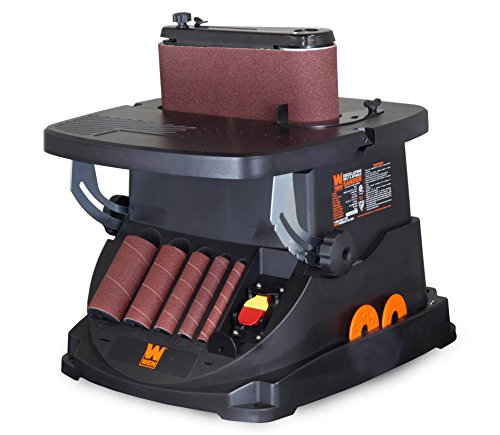 WEN 6524 Oscillating Belt and Spindle SanderCheck Amazon offer
 Triton TSPST450 450W /3.5 Amp Oscillating Spindle & Belt SanderCheck Amazon offer
Compare the approaches
| Decision | First option | Second option |
|---|---|---|
| Documented belt | WEN 6524: 4 × 24 in. | Triton TSPST450: 100 × 610 mm regional record |
| Documented spindle range | Five 4-1/2-in.-high sizes, 1/2–2 in. | Five 4-1/2-in. nominal sizes, 13–51 mm |
| Table record | 0–45° table | 0–45° front table section in cited regional manual |
| Identity limit | Current U.S. 120V documentation | Verify local voltage, plug, manual and supplied package |
| Best workflow | Mixed edges that can be processed in stages | Same, when the regional package and support arrangement fit |
| Stop rule | Skip if the belt is redundant or changeovers dominate | Skip if regional identity or exact consumable fit is unresolved |
Separate the two sanding geometries
The spindle reaches a concave edge that a flat belt surface cannot enter. The supported straight section of the belt can address straight edges and some outside curves within the machine's intended uses. Neither mode automatically supplies the accuracy of a jointer or a template-guided cutting operation. Consider each mode as a different contact geometry. When comparing machines, identify the usable work-support arrangement in both configurations, rather than assuming the table behaves identically after the belt assembly is removed.
Establish comparable real models
The WEN 6524 and RIDGID EB4424 manuals each specify a 4-by-24-inch abrasive belt. Triton's TSPST450 manual uses the regional label 100 by 610 mm; that nominal metric label is close to 4 by 24 inches but is not a mathematical conversion or proof that every belt listing fits. BAUER 191511E-B is another documented combo, while RIDGID R4840 is a separate generation whose missing technical fields must not be filled from EB4424. Record the exact model, region, manual and abrasive label before comparing packages or ordering refills.
Inspect the conversion sequence
Read the exact sequence for disconnecting power, removing or installing the belt assembly, selecting the drum or direct-mount sleeve, fitting the matching insert and washer, and checking the completed setup. WEN 6524 and RIDGID EB4424 both use a direct-mounted 1/2-inch sleeve while their four larger documented sizes use rubber drums; that shared arrangement does not make their hardware interchangeable. Count conversions on a real batch. Six brackets completed belt-first and spindle-second require one mode change, while a trial-fit part that alternates after every adjustment may make two ready stations more useful.
Treat belt tracking as a buying consideration
The belt must be installable, tensioned, and tracked using the adjustments described by the manufacturer. Study access to those controls, the replacement belt size, and the material stop or work-support arrangement. Ask whether the setup can be maintained with the machine in your intended bench location. A wall behind the tool or crowded storage on either side can make ordinary servicing awkward. Do not choose a machine solely because replacement belts share a familiar nominal size; fit, construction, and approved use still matter.
Check bevel work in both modes
A tilting table can broaden the range of supported edge work, but published angles do not describe the whole working surface. WEN lists 0–45 degrees for the 6524; RIDGID lists up to 48 degrees for EB4424; Triton's cited manual describes a 0–45-degree front table section. Confirm which surface moves, the insert required in spindle mode, and the usable support beside the belt. Rehearse the longest part with the machine disconnected: a base that fits the bench may still leave too little sweep, hose clearance or hand support for the project.
Choose a combo for a named workflow
A good combo project is a batch of brackets with suitable straight mounting edges and concave decorative cutouts. A weak case is a shop that sands almost entirely inside curves or already owns a suitable belt station. Add both abrasive inventories, the removed assembly's protected storage, model-specific inserts and washers, and clear access to the tracking control and dust port. If any of those requirements cannot be accommodated at the proposed bench, the advertised shared footprint is not the usable footprint.
For six matching brackets, write the order as six straight edges followed by six inside curves. That batch needs one change to spindle mode. A single custom-fit bracket may require alternating between the two edges after every trial fit, multiplying the changes. Count that difference before deciding whether the shared station saves effort; the number of functions stays the same, but the work sequence determines their convenience.
Questions about Belt and Spindle Combo Sanders: What to Compare
Can a combo replace every other sander?
No. Its belt and spindle cover particular edge-shaping tasks. Broad surface finishing, thickness control, and detailed hand sanding may still require other methods or machines.
Are all combo parts interchangeable?
No. Similar-looking drums, washers, inserts, and belt assemblies should be treated as model-specific unless the manufacturer explicitly lists compatibility for the exact part.
What is the main practical compromise?
Only one mode is generally ready at a time. The importance of conversion depends on whether your work can be batched or must alternate between straight and curved edges repeatedly.