accessories
Abrasive Cleaning Accessories: What to Buy
An abrasive cleaner can be a useful consumable, but the label must match the application. A product sold for belts and discs should not automatically be treated as approved for a small oscillating sleeve. Shopping decisions should distinguish removable loading from worn or damaged abrasive, and should account for the manufacturer's permitted cleaning method. Check which abrasive formats the cleaner names and what condition it can address before adding it to a refill order.
As an Amazon Associate I earn from qualifying purchases. How affiliate links work.
 POWERTEC 71002-P2 Abrasive Cleaning Stick for Sanding Belts & Discs 8-1/2" 2PK | Natural Rubber Eraser - Woodworking Shop Tools for Sanding PerfectionCheck Amazon offer
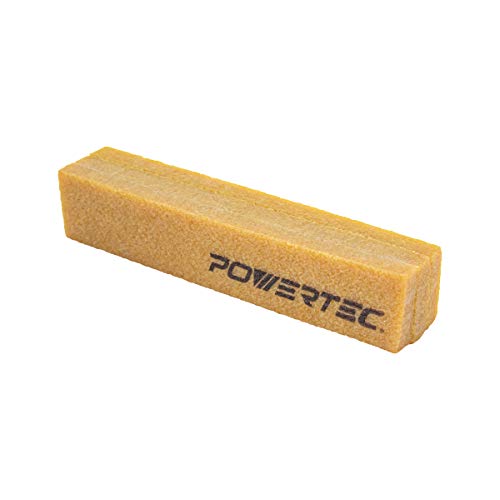 POWERTEC 71002 Abrasive Cleaning Stick for Sanding Belts & Discs 8-1/2" | Natural Rubber Eraser - Woodworking Shop Tools for Sanding PerfectionCheck Amazon offer
Read the named abrasive formats first
Manufacturers often identify the formats a cleaning product is designed for. Pro-Stik's W1305 is labelled as an abrasive belt and disc cleaner. Pro-Stik W1305. That wording supports a belt-and-disc shopping category; it does not establish compatibility with every sleeve or every machine. Before adding a cleaner to a spindle-sander order, check both the cleaner's instructions and the sander's permitted cleaning procedure. If sleeve use is not documented, ask the manufacturers for guidance. Do not expand a listing's scope merely because the cleaning material looks similar to another product marketed for a different abrasive format.
Separate loading from wear in the purchase decision
Abrasive that appears clogged and abrasive that has lost effective cutting grain are different problems. A cleaner cannot be assumed to restore missing grain, repair a damaged backing, or make a failed seam serviceable. When deciding whether to buy cleaning supplies or replacement abrasives, describe the visible condition and consult the relevant instructions. Keep damaged consumables out of the ready-to-use stock. For budgeting, treat the cleaner as a potential maintenance aid whose usefulness depends on the actual loading and approved application, not as a guaranteed multiplier of abrasive life. Avoid accepting a seller's broad cost-saving claim without considering whether its stated conditions match the material and abrasive you use.
Compare shape and handling provisions
Cleaning sticks are sold in different lengths and cross-sections, and some include a handle. Pro-Stik describes its handled W1308 as an accessory for larger, more powerful belt and disc sanders. Pro-Stik W1308. That context matters: a larger or handled product is not automatically the correct choice for a compact sleeve. Read the instructions for minimum usable size, handling, and disposal of a worn remnant where supplied. Favor a product with clear application guidance over an unlabelled block sold only by dimensions. Compare the specified grip and handling method alongside block size, especially when the cleaner will be used near a compact sanding surface.
Avoid undocumented solvents and improvised substitutes
Do not infer that a household solvent or chemical cleaner is suitable for abrasive backing, adhesive, rubber drums, or the sander's plastic parts. Those are different materials, and a cleaning method acceptable for one may be inappropriate for another. Buy a product only for the documented purpose, and retain its instructions with the machine's maintenance information. Likewise, an improvised rubber object is not equivalent to a labelled abrasive cleaner just because it resembles one. This guide does not prescribe a powered cleaning technique or a chemical treatment. If the machine manual and accessory directions do not establish a compatible procedure, the uncertainty should be resolved before the item becomes part of the shop workflow.
Track useful results without promising a lifespan
If an approved cleaning accessory is used, keep simple observations: abrasive product, material being sanded, visible loading, and whether the abrasive returned to acceptable work. Separate those notes from replacement decisions caused by tears, seam problems, or ordinary grain wear. A few observations can help decide whether keeping the cleaner in stock is worthwhile for your tasks, but they do not justify a universal life-extension percentage. Store the cleaner so its identity remains visible and its usable condition can be checked before use. Reorder the same documented product when appropriate; substituting an unlabelled item removes the application evidence that made the original purchase reasonable in the first place.
If a seller bundles a cleaner with refills, evaluate the cleaner independently. Inclusion in a commercial bundle does not replace application instructions or establish that the cleaning method is approved for every abrasive in the package.
Questions about Abrasive Cleaning Accessories: What to Buy
Can a belt-and-disc cleaning stick be used on every sleeve?
Do not assume so. Confirm sleeve use and the procedure with the cleaner and machine instructions.
Can cleaning repair worn-out abrasive?
It should not be relied on to replace missing grain or repair damaged backing or seams.
Is a handled cleaner always safer or better?
Choose the handling design specified for the application; a product intended for large belt sanders is not automatically suitable for a small sleeve.

