accessories
Drill Sanding Drum Kits: Compatibility Before Purchase
Drill-mounted sanding drums are a separate accessory category from the drums supplied with a dedicated spindle sander. A kit listing may name several possible host tools, but compatibility still depends on the instructions for both the drum and the specific machine. Before buying, verify the host tool, shank, refill sizes and operating limits. A drill-press conversion or use in a router cannot be justified by a drum-kit listing alone.
As an Amazon Associate I earn from qualifying purchases. How affiliate links work.
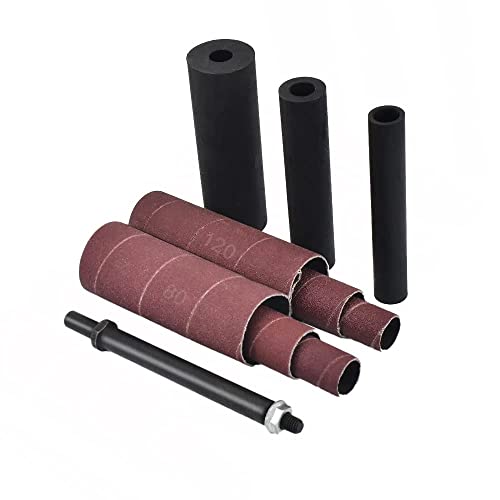 scottchen PRO Spindle Sander Adaptor 4-1/2" x 1/2" with Rubber Sanding Drum Kit OD 3/4", 1", 1-1/2" and Sandpaper Sleeves Grit# 80,120 - S/10Check Amazon offer
 Olamochi Spindle Sander Drum & Sleeve Replacement KitCheck Amazon offer
Verify both sides of the proposed pairing
A drum manufacturer's host-tool claim is one part of the compatibility check. The drill or drill press must also permit the accessory and the proposed type of work under its own instructions. Grizzly markets its G2500 sanding drum set for several named tool categories, including drills and drill presses. Grizzly G2500. That broad product description is not approval for every individual machine in those categories. Identify the exact host model and ask its manufacturer if the intended accessory use is unclear. Without that confirmation, do not assume the presence of a chuck establishes suitability for lateral sanding loads or the proposed setup.
Check shank and chuck requirements explicitly
The accessory needs a compatible shank and an approved holding arrangement. Read the drum maker's specifications and the host tool's chuck capacity and accessory instructions. A shank that can physically enter a chuck has not answered questions about permitted application, engagement, or operating limits. Keep those requirements together in the purchasing record so a future refill or replacement drum does not lose its host-tool context. Avoid adapters intended only to make an otherwise unsuitable pairing possible. In particular, do not transfer a drill sanding drum to a router on the basis of shank resemblance. A router is a different machine category with its own accessory requirements and operating characteristics.
Separate drum size from refill specification
A kit may advertise its rubber drum dimensions while the replacement abrasive listing uses a separate sleeve specification. Preserve that distinction when recording the kit. Grizzly's G2501 listing identifies a long-drum set, illustrating that drum kits are available in different axial formats. Grizzly G2501. Do not assume that a benchtop spindle-sander sleeve fits a drill drum because one diameter matches. Ask for the kit's exact replacement sleeve SKU and supported dimensions. If a seller cannot identify refills, include that limitation in the buying comparison; an inexpensive kit can be inconvenient if its consumable supply is uncertain once the included sleeves are exhausted.
Compare documented limits rather than borrowed settings
Look for the accessory's stated speed limits and any host-specific restrictions in its instructions. Then verify that the chosen machine can operate within the applicable requirements. Do not substitute a spindle sander's speed, an online demonstration, or another drum's limit for the actual accessory documentation. The presence or absence of oscillation also means a drill accessory should not be described as functionally identical to a dedicated oscillating spindle sander. For the shopping decision, write down any missing limit and resolve it with the manufacturer before purchase. A product with complete application information is easier to evaluate than one marketed through broad compatibility language without instructions that define its use.
Choose a kit with an identifiable replacement path
Count useful drum sizes, included sleeves, and available refill grits separately. A large piece count may consist mostly of abrasives rather than additional support drums. Favor a kit whose individual components are clearly identified, with replacement sleeves available through a traceable product line. Keep its instructions and packaging rather than mixing the drums into a general chuck-accessory drawer. Mark the approved host machine in your storage record so a shared workshop does not treat the kit as permission to use any available tool. If your intended work is frequent and the host-machine documentation is restrictive or uncertain, compare a purpose-built sander as a separate purchase instead of trying to solve uncertainty with more adapters.
For a kit shared among several people, include the instructions in the storage case. The approved application should travel with the accessory so the next user can verify its requirements before choosing a host tool.
Questions about Drill Sanding Drum Kits: Compatibility Before Purchase
Does a drill-drum listing approve every drill press?
No. Check both the accessory instructions and the exact host-machine documentation.
Can I use a drill sanding drum in a router?
Do not infer router suitability from shank size. Use only accessories explicitly approved for the specific machine and application.
Will ordinary spindle-sander sleeves fit a drill drum?
Only if the drum maker or supplier confirms the exact refill compatibility; matching diameter is insufficient.

