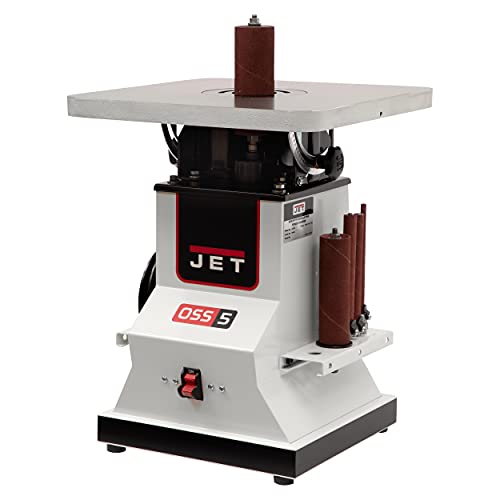
comparisons
Spindle Sander vs Drum Sander: Curves or Flat Faces?
For an inside curve, examine a spindle sander; for broad board faces, examine a conveyor drum sander. Both use cylindrical abrasives, but the spindle brings a vertical sleeve to a supported edge, while the conveyor feeds a board beneath a horizontal drum. This guide helps decide which task should take priority in your shop. Detailed drum-sander setup and performance comparisons require the documentation for the conveyor machine you are considering.
As an Amazon Associate I earn from qualifying purchases. How affiliate links work.
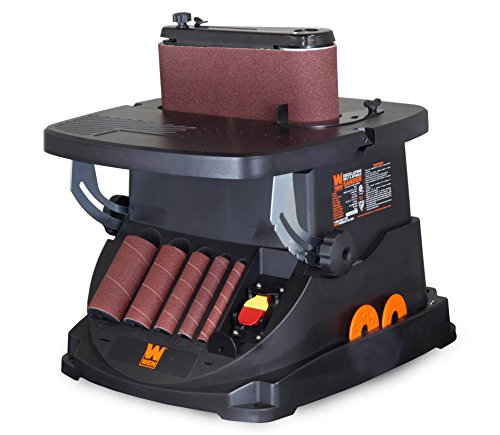 WEN 6524 Oscillating Belt and Spindle SanderCheck Amazon offer
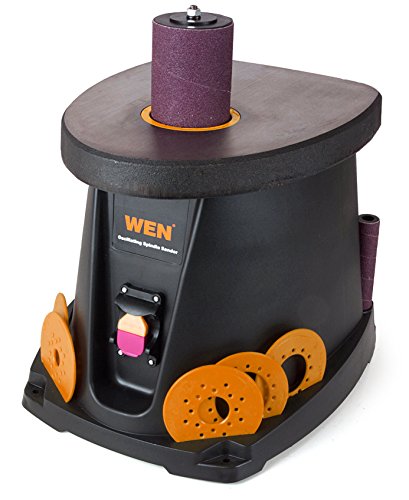 WEN 6510T 3.5 Amp Oscillating Spindle Sander,BlackCheck Amazon offer
Compare the approaches
| Decision | First option | Second option |
|---|---|---|
| Primary contact | Vertical sleeve against an edge | Horizontal drum across a broad face |
| Work movement | Operator guides supported work | Conveyor feeds suitable stock |
| Typical need | Inside curves and shaped edges | Broad flat surface sanding |
| Space to assess | Workpiece sweep around the table | Approved feed and support path |
Locate the surface that needs improvement
Picture a curved cutting-board blank. Its broad upper face is one surface, and its scalloped perimeter is another. Refining an inside curve calls for contact with the perimeter, which is the spindle sander's natural role. Sanding across a broad face is a different task, suited to a machine designed to carry stock beneath a sanding head. A single project can need both operations. Calling both machines drum sanders informally can hide this important difference when searching for advice or replacement abrasives.
If the surface you need to sand is the broad face rather than the shaped edge, use the drum sander buying comparisons to investigate conveyor machines, stock capacity and complete setup requirements. That is a different purchasing decision from choosing a vertical spindle and its sleeves.
Understand how the work is supported
On a spindle machine, the operator supports and guides the work on a table around the vertical abrasive. On a conveyor drum sander, the machine's feed arrangement carries appropriately sized stock through the sanding area. Those layouts lead to different constraints. A spindle purchase requires attention to curve access, edge height, and hand-controlled support. A conveyor purchase requires attention to its own permitted stock dimensions and feed path. Do not transfer the operating technique or capacity assumptions from one category to the other.
Use manufacturer examples to confirm the categories
Grizzly's G0739 is identified as a benchtop oscillating spindle sander. The company's G0458ZX is an open-end conveyor drum sander intended for broad, flat workpieces. These examples clarify terminology without implying equivalent capacity or cost. The shared word drum refers to an abrasive form, not interchangeable machines. If a search result describes feeding a panel under a sanding head, it is discussing a different category from the small vertical sleeves used to refine the inside curve of a bracket.
Avoid asking either tool to become the other
A vertical spindle does not provide a conveyor or a controlled gap for processing a broad board face to consistent thickness. A conveyor drum does not enter a concave perimeter the way a small spindle can. Turning a workpiece into an unsuitable orientation does not erase those limitations. Choose a tool designed for the surface and follow its manual. Also avoid assuming that either machine automatically corrects every geometric defect in rough stock; preparation and reference surfaces remain part of the larger woodworking process.
Prioritize the recurring bottleneck
If most of your lost time is hand sanding scroll-sawn curves, a spindle machine addresses the immediate bottleneck. If the repeated task is sanding broad panels, a spindle is unlikely to be the priority just because it is smaller. List the last several projects and separate edge work from face work. Estimate which operation recurs and which already has an adequate method in your shop. This produces a more useful purchase sequence than comparing two machines as though they were rivals for the same pass.
Allow space for the right process
The spindle station needs clearance for the workpiece to move around the table. A conveyor machine needs its own prescribed feed and support space, which can extend beyond the cabinet footprint. Plan extraction according to each machine's requirements, not by matching port diameter alone. When both tools are justified, assign them separate roles in the workflow and avoid buying duplicate capability by terminology mistake. For occasional work outside either machine's role, a suitable hand tool or another established method may be more sensible than a forced substitution.
Sketch a wooden tray and mark the surface that needs work. Highlighting the broad base identifies a surface-sanding job; highlighting a concave handle cutout identifies the access a spindle provides. Keep both areas as separate steps if both need sanding, then note how often you make similar parts. That face-or-edge distinction is more useful than the word drum, which can appear in listings for quite different tools.
Questions about Spindle Sander vs Drum Sander: Curves or Flat Faces?
how much does a drum sander weight
If you mean a conveyor drum sander, weight varies substantially by model and configuration. Check the exact manufacturer specification and distinguish machine weight from shipping weight. A compact spindle sander belongs to a different category and is not a reliable weight comparison.
which drum sander to buy
First decide whether you need a vertical spindle for inside curves or a conveyor drum machine for broad faces. Then compare the exact model’s permitted workpiece sizes, support, installation, and extraction requirements. This guide does not name a tested conveyor-sander winner.
which drum sander
For curved-edge work, search specifically for an oscillating spindle sander. For sanding broad flat faces with a conveyor, search for a conveyor drum sander. The shared word drum describes an abrasive form and can otherwise lead to the wrong tool category.
when drum sander
A conveyor drum sander becomes relevant when repeated broad-face sanding is the operation you need to address. A spindle sander becomes relevant for supported shaped-edge work, especially suitable inside curves. The purchase timing depends on which task is the recurring bottleneck.
how much are drum sanders
Prices vary by category, model, package, and current offer. Compare the current complete cost, including delivery, required support, abrasives, and extraction arrangements. No fixed price is quoted here, and a low-priced spindle machine should not be mistaken for an equivalent conveyor drum sander.