comparisons
Spindle Sander vs Belt Sander: Match the Contact Shape
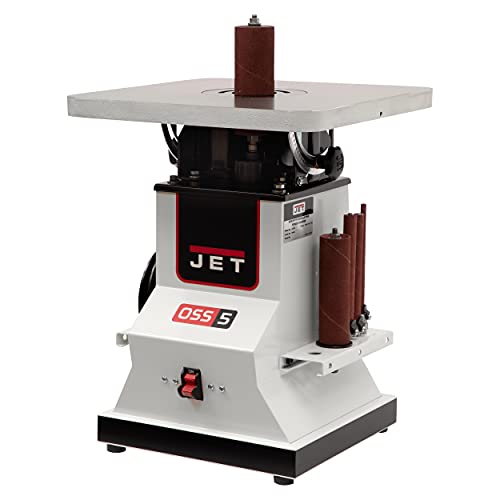
The decisive difference between a spindle sander and a belt sander is the shape of the supported abrasive surface. A spindle can reach an inside curve; a flat belt section provides a straighter contact area. Belt sanders also exist in handheld and stationary forms, so define the machine before comparing it. This guide mainly considers a stationary belt surface alongside a benchtop spindle sander.
As an Amazon Associate I earn from qualifying purchases. How affiliate links work.
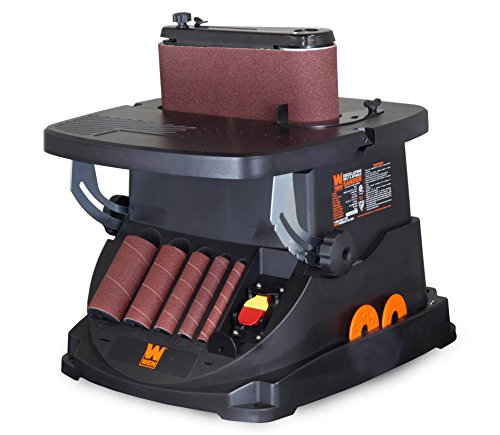 WEN 6524 Oscillating Belt and Spindle SanderCheck Amazon offer
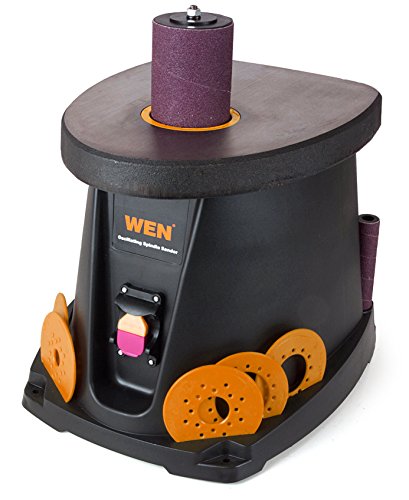 WEN 6510T 3.5 Amp Oscillating Spindle Sander,BlackCheck Amazon offer
Compare the approaches
| Decision | First option | Second option |
|---|---|---|
| Contact geometry | Cylindrical sleeve | Belt, often supported by a flat platen |
| Strong reason to choose | Concave edges | Suitable straight edges and outside surfaces |
| Common adjustment | Sleeve diameter and insert | Belt tension and tracking |
| Shared station option | Spindle mode on a combo | Belt mode on a combo |
Choose the abrasive shape for the edge
A concave cutout needs an abrasive small enough to enter the recess. A spindle sleeve supplies that cylindrical contact, with diameter selected to suit the curve. A belt backed by a flat platen presents a longer, straighter surface that can be useful on appropriate straight edges and outside contours. The different contact areas influence how the work is guided. Neither geometry guarantees a correct shape: a localized spindle contact can create a hollow, while an improperly presented edge can become uneven on a belt.
Clarify what kind of belt sander is offered
A handheld belt sander moves over secured work. A stationary belt machine generally supports the part against its sanding arrangement, with details varying by design. A belt-and-spindle combo is another layout, sharing a station between those functions. Grizzly G1014Z illustrates a stationary belt-and-disc machine, while WEN 6524 documents a belt-and-spindle combination. Avoid comparing all belt sanders as one interchangeable tool. The available table, stop, platen, and approved orientation matter as much as the fact that an abrasive belt circulates.
Compare stock preparation and final shaping
If a bandsaw has left a curved edge close to its layout line, a spindle can refine that contour in small controlled steps. If a suitable straight edge needs abrasive refinement, a supported belt can offer a more useful contact surface. Large amounts of waste should be addressed with an appropriate cutting method before either sanding stage. Using coarse abrasive to rescue an unnecessarily rough blank can increase heat, abrasive consumption, and the chance of losing the intended geometry.
Keep reference surfaces and joins in mind
A smooth-looking edge is not automatically straight, square, or ready for a precision joint. The spindle follows the operator's movement rather than a fixed reference. A belt can also remove material unevenly if the presentation is inconsistent or the supported abrasive is not appropriate for the task. Check critical dimensions with suitable references after sanding. If a project requires a machined glue joint or a repeatable cut, choose the correct upstream tool rather than assuming either abrasive machine becomes a jointer by technique alone.
Evaluate the one-station alternative
A combo makes sense when both contact shapes are repeatedly needed and bench space is valuable. Consider whether the workflow can be grouped into stages, because switching attachments for each component can interrupt progress. Look at storage for the unused parts and the dust connection in each mode. If your work is almost entirely inside curves, a dedicated spindle may be the simpler arrangement. If long straight-edge work dominates, examine a belt machine designed for that requirement rather than adding a spindle function you seldom use.
Select by geometry before speed
Published spindle revolutions and belt surface speed describe different motions. Comparing their numbers directly does not establish which sands faster or better. Match the machine to the work, then compare abrasive availability, support, adjustment, and safe handling. Follow each manual's feed direction and workholding requirements, which are specific to the design. For a mixed shop, the tools can be complementary. The stronger purchase is the one that addresses the current limitation in your workflow with an approved, controllable setup.
On a bracket drawing, mark the inward scallop and long straight mounting edge separately. Record a sleeve-size requirement for the scallop and a straightness requirement for the mounting edge. Then price the workflow that satisfies both: a combo, two stations, or one powered tool with appropriate hand work. The frequency of those two operations determines whether a second abrasive format earns a permanent place in the shop.
Questions about Spindle Sander vs Belt Sander: Match the Contact Shape
Can a belt sander sand inside curves?
Some belt machines have manufacturer-approved uses around particular contact areas, but a flat platen cannot enter a tight concave recess. Check the exact design and manual instead of improvising around an exposed roller.
Is a spindle sander better for straight edges?
Its localized curved contact is usually not the main reason to buy it for straight-edge work. Assess a suitable supported belt or another appropriate process when straight geometry is the primary requirement.
Should I compare RPM with belt speed?
No direct ranking follows from those figures. They describe different movement, and sanding results also depend on abrasive, support, contact, material, and feed technique.