comparisons
Spindle Sander vs Disc Sander: Curves, Ends, and Angles
A spindle sander brings a cylindrical abrasive to curved edges. A disc sander presents a flat circular abrasive that can suit supported end and edge work. The useful distinction is not simply curves versus straight lines: both can participate in shaping, but their contact geometry and safe working zones differ. Select around the surface, support, and angle control your actual component requires.
As an Amazon Associate I earn from qualifying purchases. How affiliate links work.
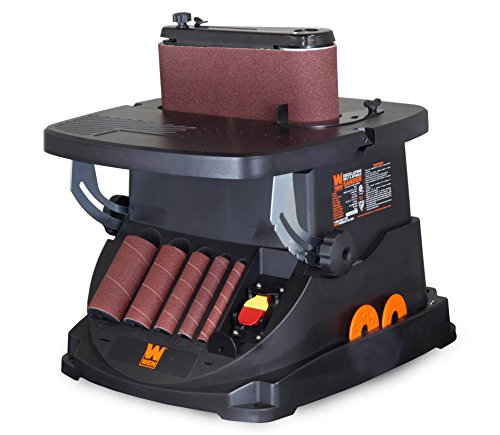 WEN 6524 Oscillating Belt and Spindle SanderCheck Amazon offer
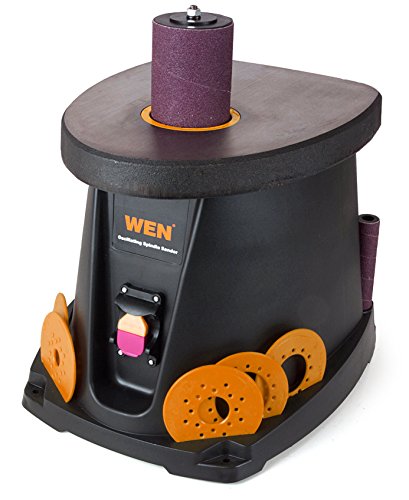 WEN 6510T 3.5 Amp Oscillating Spindle Sander,BlackCheck Amazon offer
Compare the approaches
| Decision | First option | Second option |
|---|---|---|
| Abrasive form | Cylindrical sleeve | Flat circular disc |
| Inside curves | Relevant when diameter and access fit | Flat face cannot enter the recess |
| Common project focus | Shaped perimeters | Suitable ends, edges, and angles |
| Setup reference | Table, sleeve, and insert | Table, working zone, and approved guide |
Start with concave access
An inside curve wraps around a cylindrical contact area, so the spindle is the natural category to examine. A flat disc cannot enter that recess. Outside curves can be approached using different methods, but the work must remain supported and controlled. Do not interpret a disc's circular outline as a cylindrical sanding surface. The active abrasive is on the flat face of the disc, which is why its uses and handling differ from those of a sleeve rotating around a vertical spindle.
Recognize where a disc station may help
A suitably designed disc station can offer a flat abrasive surface and table arrangement for particular end, edge, and angle operations. Grizzly's G1014Z combines a disc with a belt and documents those as distinct sanding functions. The relevant features are the table, permitted work support, abrasive face, and manufacturer's operating instructions. A miter slot or angle scale may help establish a setup, but neither guarantees precision without checking the actual work. Small components still need an approved means of control.
Understand that motion varies across a disc
Different points on a rotating disc travel different distances in one revolution, and the abrasive moves in different directions across its face. This makes the manufacturer's designated working area and feed guidance essential. Do not borrow a spindle-sanding movement pattern and apply it to whichever part of the disc feels convenient. The spindle also has a prescribed feed relationship, but the setup is different. Compare the manuals before buying if you are new to either type of machine.
Match angle requirements to the table
For a beveled concave edge, a tilting-table spindle model may be relevant. For suitable end-angle sanding, a disc station's table and guiding arrangement may be more appropriate. Check the permitted table range, locking method, and required gap at the abrasive. Visualize the entire component at the intended angle, including what happens to the far end of a long piece. The usable setup is more informative than a printed maximum tilt that cannot be comfortably applied to your work.
Consider abrasive changes and material removal
Spindle sleeves are selected by diameter and length; disc abrasives must match the machine's disc size and attachment requirements. Changing an abrasive form is not the same job as choosing a grit. Keep coarse removal separate from final surface refinement in your project plan. Excessive sanding to compensate for inaccurate rough cutting can alter the intended dimensions on either machine. Where finish quality is critical, inspect the scratch pattern and edge geometry between stages rather than assuming an apparently smooth surface is complete.
Buy the station your parts repeatedly visit
Review a few completed or planned projects. If they contain recurring inside curves, the spindle fills a clear role. If suitable end and angle work is the main missing operation, examine a disc station and its approved support methods. A belt-and-disc machine may already cover some tasks you hoped to buy a spindle for, but concave access remains a separate capability. Choose based on that missing function and the workpiece dimensions. Owning both is justified when each handles a recurring stage, not merely because their names sound similar.
Mark the mating ends before sanding a part with a concave center and angled joints. The spindle can address the inside curve, while the ends need their own angle-control setup, potentially at a suitable disc station. Preserve those end references as you refine the center. At the disc, the defined working zone and adequate support still govern the operation; an awkward component does not justify using an unsuitable area of the abrasive.
Questions about Spindle Sander vs Disc Sander: Curves, Ends, and Angles
Can a disc sander reach a tight inside curve?
Its flat abrasive face cannot enter a concave recess like a cylindrical sleeve. A spindle is the relevant category when the opening and workpiece can be safely supported.
Is a disc sander automatically more accurate?
No. Accuracy depends on machine condition, setup, work support, abrasive, and inspection. A table or angle guide can support a process without guaranteeing the finished result.
Can I use any part of a sanding disc?
Follow the exact manual’s designated working area and feed instructions. Abrasive direction changes across the disc, so the safe approach is machine-specific rather than interchangeable with spindle technique.