comparisons
Spindle Sander vs Drill Press: Keep the Jobs Distinct
A drill press is designed around controlled drilling, while a spindle sander is designed around supported abrasive edge work. The existence of a sanding drum that fits a chuck does not establish that a particular drill press is approved for side-loaded sanding. For regular curved-edge sanding, examine a dedicated spindle machine. Consider an attachment only when the exact machine manual and accessory instructions explicitly authorize the complete use.
As an Amazon Associate I earn from qualifying purchases. How affiliate links work.
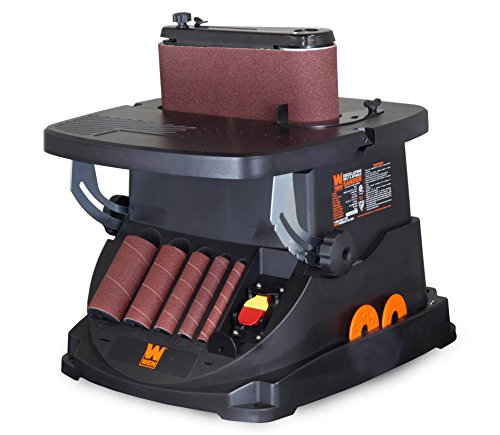 WEN 6524 Oscillating Belt and Spindle SanderCheck Amazon offer
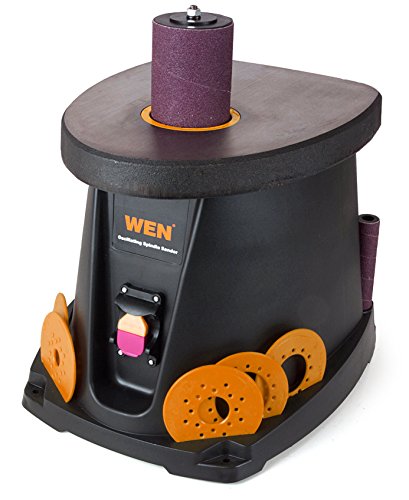 WEN 6510T 3.5 Amp Oscillating Spindle Sander,BlackCheck Amazon offer
Compare the approaches
| Decision | First option | Second option |
|---|---|---|
| Designed task | Supported abrasive edge sanding | Controlled hole drilling |
| Vertical motion | Powered oscillation on oscillating models | Drilling feed; not assumed sanding oscillation |
| Sanding permission | Defined by spindle-sander manual | Requires explicit machine and accessory approval |
| Buying priority | Frequent curved edges | Required drilling capacity |
Compare intended functions first
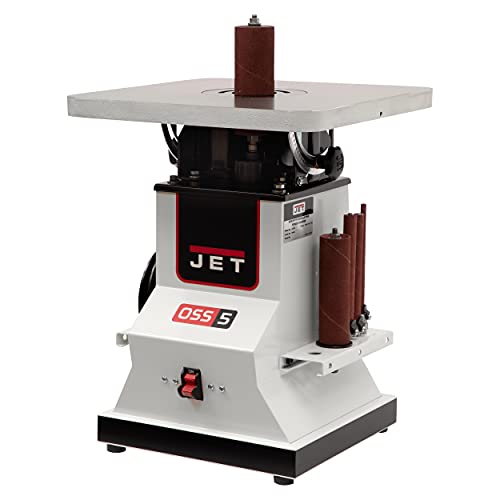
JET describes its woodworking drill presses as machines for accurate, repeatable hole drilling. A spindle sander such as Grizzly G0739 is documented for abrasive edge work using a vertical rotating and oscillating spindle. Those intended functions are different even though each machine has a table and rotating shaft. A familiar outline is not engineering approval for substitution. If drilling is the missing operation in your shop, buy for drilling. If edge sanding is the bottleneck, investigate equipment intended to carry that load.
Do not infer approval from chuck fit
An accessory shank may fit a chuck while the proposed operation remains outside the machine's intended use. Chuck retention, spindle support, permissible loads, and work support depend on the exact design. Generic internet advice cannot establish those details for every drill press. Read the manufacturer's manual and seek explicit confirmation where the wording is unclear. An attachment maker's broad compatibility claim should not override a machine prohibition or silence about the use. Without clear approval, choose a dedicated sanding method.
Examine the sanding support system
A purpose-built spindle sander combines the abrasive with a worktable, size-matched opening arrangements, and model-specific hardware. The table supports the part near the abrasive as instructed. A drill-press table designed for drilling is not automatically the equivalent sanding surface, and a homemade table does not by itself establish an approved conversion. A buying comparison should therefore consider the whole system rather than the price of a sanding drum alone. Work support, extraction, and operating guidance belong in that comparison.
Account for oscillation without improvising it
An oscillating spindle moves vertically while it rotates, changing which portion of the abrasive contacts the edge. A conventional drill press does not become an oscillating sander merely because its quill can move. Do not repeatedly manipulate the feed mechanism during side-loaded sanding as an assumed substitute. Whether any attachment operation is allowed, and how it is performed, must come from the relevant manufacturer instructions. For recurring sanding, purchasing the documented motion as part of a dedicated machine avoids an unsupported conversion premise.
Think about preserving the drilling station
Even an explicitly approved accessory can require setup time, cleaning, and a return to drilling adjustments. Consider how often you would remove the drill, change the table arrangement, connect extraction, and then restore the drilling setup. If sanding occurs once in an unusual project, a permitted accessory might warrant evaluation. If it occurs throughout every batch, a separate station may be more convenient. The question is the complete workflow, not whether one tool can theoretically be made to rotate both a drill bit and an abrasive.
Choose an approved route for the actual frequency
List the number and size of curves you need to sand. For regular work, compare a dedicated spindle sander's supported capacity, sleeve availability, and installation requirements. For very occasional work, appropriate hand sanding or another established method may meet the need. If considering a drill-press accessory, require explicit approval for that exact machine and setup before purchase or use. This guide provides no conversion instructions or assumption of safe lateral loading. A modest saving is not a reason to fill missing engineering guidance with trial and error.
A shop that drills every day and sands curves only occasionally has a frequency question to answer before buying another tool. Locate explicit authorization for the proposed drum accessory and setup in the drill-press documentation. Without it, compare appropriate hand sanding with a dedicated spindle station for those occasional curves. Daily use of the drill press does not establish that its chuck and bearings are intended for the sanding loads.
Questions about Spindle Sander vs Drill Press: Keep the Jobs Distinct
Can I put a sanding drum in any drill press?
No general permission applies. Use such an accessory only when the exact drill press and accessory documentation explicitly approve the operation and required setup. Chuck fit alone is insufficient.
Does a drill press oscillate like a spindle sander?
A conventional drilling feed is not the same as a dedicated powered oscillation mechanism. Do not assume that manually moving the quill during sanding is an approved substitute.
What should I buy for frequent inside-curve sanding?
Investigate a purpose-built spindle sander that fits the curve, edge height, and support requirements. Keep the drill-press decision focused on the drilling operations you actually need.