comparisons
Oscillating vs Fixed Spindle Sanding: What Changes?
An oscillating spindle rotates and travels vertically. A non-oscillating, or fixed-height, spindle rotates without that powered up-and-down movement. In this comparison, fixed describes the spindle motion, not whether the table tilts. Oscillation changes the contact path across the abrasive, but it does not eliminate the need for correct feed, suitable grit, work support, and inspection. Compare the whole sanding system rather than treating one motion specification as a quality score.
As an Amazon Associate I earn from qualifying purchases. How affiliate links work.
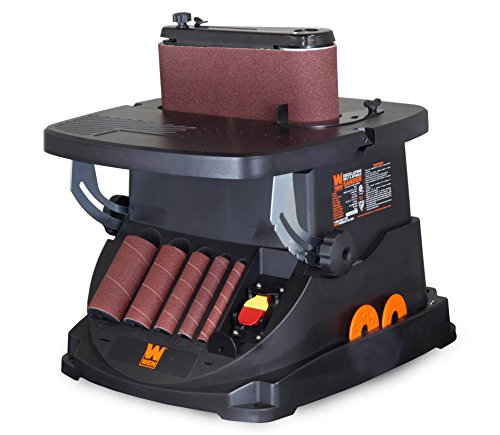 WEN 6524 Oscillating Belt and Spindle SanderCheck Amazon offer
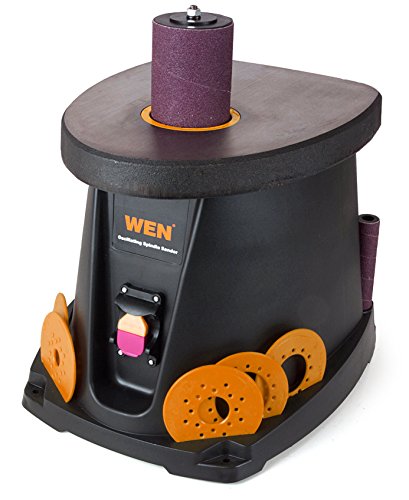 WEN 6510T 3.5 Amp Oscillating Spindle Sander,BlackCheck Amazon offer
Compare the approaches
| Decision | First option | Second option |
|---|---|---|
| Rotational motion | Present | Present |
| Vertical motion | Powered repeated travel | No powered oscillation |
| Contact band | Moves along the sleeve | Remains at the supported work height |
| Finish guarantee | None; setup still matters | None; setup still matters |
Follow the contact patch
With the work supported at a consistent table height, a non-oscillating abrasive tends to use the same band of its sleeve for a given edge thickness. Vertical oscillation moves additional portions of the abrasive through that contact. This explains the basic difference without promising a particular percentage of longer sleeve life or faster sanding. Those outcomes depend on the material, abrasive condition, geometry, and operating method. The motion is one contributor to the process rather than a guarantee that every pass will be even.
Distinguish speed, rate, and stroke
Spindle revolutions describe rotation. Oscillations per minute describe the repeated vertical movement, while stroke describes its travel distance. These are different quantities and should not be ranked as if a larger number always means superior sanding. WEN 6524 and RIKON 50-300 illustrate manufacturer-documented oscillating designs with different specifications. A meaningful comparison asks how the complete machine supports your work and what the manufacturer permits. Numerical differences alone do not establish a measured winner for finish, temperature, noise, or abrasive consumption.
Keep usable height separate from sleeve length
Because the spindle moves relative to the table, the full sleeve length is not automatically the height of work that can be sanded in one supported position. Check the exact machine's permitted workpiece height and the relationship between table and abrasive through the complete stroke. A nominally long sleeve should not be used to justify lifting stock off the table or adding an unapproved platform. This is especially relevant when purchasing for thick furniture components that may exceed the ordinary edge height of small hobby projects.
Recognize what oscillation does not correct
A dull or loaded sleeve can still cut poorly. Excessive pressure or lingering contact can still damage the intended curve. An oversized table opening can still leave inadequate support. Oscillation does not make those setup and technique problems disappear. Inspect the abrasive and the developing edge, use an appropriate rough-cut allowance, and choose grits for the task. If you see burning or uneven geometry, review the whole process and the manual rather than assuming a higher oscillation number would have prevented the problem.
Treat non-oscillating equipment as its own machine
A purpose-built non-oscillating sanding arrangement may have legitimate uses within its documentation. That does not authorize turning a drill press, router, or other rotating tool into one. Approval for the complete setup remains essential. Nor should you disable a working oscillation mechanism in an oscillating sander as an assumed way to create a second mode. If a machine has a documented motion control, follow its instructions. Otherwise, evaluate the design as supplied and seek service when the intended movement is not functioning.
Choose motion after confirming capacity
For a new dedicated curved-edge station, an oscillating model is a logical category to examine because it deliberately distributes contact vertically. Still compare radius access, supported work height, table adjustment, sleeve availability, and extraction. If an approved non-oscillating machine already serves an occasional task well, your next purchase may belong elsewhere in the shop. The useful decision is whether the new station solves a recurring limitation. Avoid paying for an imagined finish guarantee based on motion alone or dismissing a suitable process without considering its actual results.
For thin and thick stock, sketch the portion of the sleeve contacted at table height. Oscillation moves that contact vertically, but the thicker piece must remain within the approved capacity throughout the stroke. Check an unusually thick component against that working-height limit before comparing oscillation rates. Extra vertical motion cannot make an oversized part suitable or authorize a different support arrangement.
Questions about Oscillating vs Fixed Spindle Sanding: What Changes?
Does fixed mean the table cannot tilt?
Not here. Fixed-height means the spindle does not oscillate vertically. Table tilt is a separate feature and must be checked independently for the exact machine.
Will oscillation prevent burning completely?
No. Abrasive condition, pressure, feed, grit, material, and contact all affect heat and surface quality. Oscillation is helpful movement, not a replacement for appropriate setup and technique.
Can I stop oscillation on a machine that lacks that control?
Do not modify or disable the mechanism to create an assumed operating mode. Use only documented controls and obtain service advice if the machine no longer moves as intended.