accessories
Sanding Sleeve Dimensions and Compatibility
A sleeve dimension must answer two different questions: how wide is the abrasive cylinder, and how tall is it? Compatibility then adds the supporting drum or spindle, retaining hardware, throat insert, exact model and revision. The table below keeps six manufacturer-documented examples separate, including mixed-height and unresolved systems. Start with the sleeve-size Finder, then return here to interpret what a known, mixed or missing height means.
As an Amazon Associate I earn from qualifying purchases. How affiliate links work.
Offers are examples to inspect after the dimensional record is complete. The four cards represent different model-family refills; none is a universal match for every 4-1/2-, 5-5/8-, six- or nine-inch system.
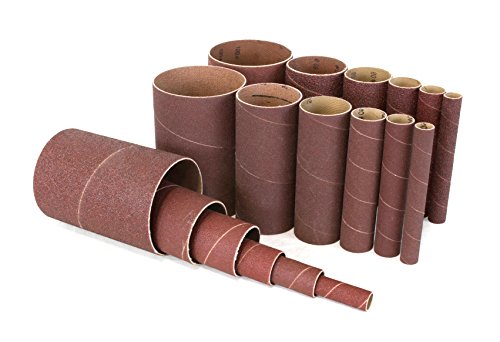 WEN 6510SPC Assorted Grits Spindle Sanding Sleeves (18 Pack)Check Amazon offer
 WEN 6535SP80 80-Grit Oscillating Spindle Sandpaper Sanding Sleeves with 5-5/8-Inch Height, 10 PackCheck Amazon offer
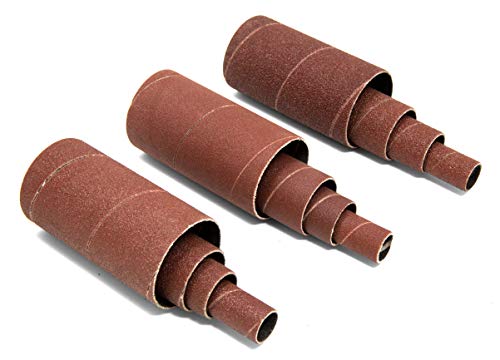 WEN 5932SPC Replacement Spindle Sanding Sleeves, Assorted Sandpaper Grits, 12 PackCheck Amazon offer
 WEN 6524SP120 120-Grit Combination Belt and Sleeve Sandpaper Set, 24-PackCheck Amazon offer
Documented sleeve records to compare
| Exact model | Abrasive dimensions | Assembly check | Evidence status |
|---|---|---|---|
| WEN AT6535 | 1/2, 3/4, 1, 1-1/2 and 2 in diameters × 5-5/8 in height | Five rubber drums and the matching throat-plate arrangement remain separate checks. | WEN 6535SP80 page names AT6535 and states each sleeve height. |
| WEN HA5932 | 1/2, 3/4, 1 and 1-1/2 in diameters × 3 in length | Four sleeves but three rubber drums; follow the portable model's size-by-size setup. | WEN 5932SPC page names HA5932 and states diameter and length. |
| JET JBOS-5 | 1/4, 1/2 and 5/8 in diameters × 6 in; 1-1/2 and 2 in × 5-1/2 in | The 3 in × 5-1/2 in spindle/sleeve system is optional, not part of the included five-size set. | JET accessory records and retained manual evidence show mixed lengths. |
| Grizzly G0739 | 1/2, 3/4, 1, 1-1/2, 2 and 3 in diameters × 4-1/2 in format | Verify rubber drum, washer and table insert for the selected size. | Manual for machines manufactured since June 2015. |
| Grizzly G0723 | Six diameters are listed; height remains unresolved at 4 versus 4-1/2 in | Use serial and manufacture date to confirm the current replacement and parts stack. | Manufacturer data-sheet and older label artwork conflict; no fit inferred. |
| Laguna SS|24T | Ten diameters from 1/4 through 4 in; sleeve lengths vary from 6 to 9 in | Check the individual spindle assembly rather than applying one height to all ten diameters. | Laguna inventory is mixed-height; exact per-size fit remains assembly-specific. |
These rows are model-specific records, not a cross-model compatibility chart. Use the linked model guide and current manufacturer part identification before ordering.
Read every dimension as a source-qualified record
The table distinguishes three evidence states. A known uniform height can be compared with a replacement listing, but still needs the named model and assembly. A mixed-height system requires a diameter-by-height pair instead of one machine-wide number. An unresolved height stays unknown until the manufacturer or supplier resolves the exact revision. This prevents a common catalog error: assigning a popular 4-1/2-inch refill to every machine whose diameter range looks familiar.
Keep diameter, height, and shaft size separate
Use diameter × height when recording an abrasive sleeve. Diameter describes the cylinder's nominal size; height describes its axial length. The metal shaft that carries the sanding assembly is another component and can have a very different diameter. The rubber support drum is also a separate part, so a specification labelled drum length should remain a drum-length entry unless the manufacturer explicitly identifies the corresponding sleeve height. Labeling the fields prevents a shaft dimension and a drum length from being mistaken for a verified sleeve size. Give every measurement a label when emailing a supplier rather than sending an unexplained pair of numbers.
A documented example from a portable machine
The TSPSP650 instruction manual lists a 76 mm sleeve length and four sleeve diameters. The resulting manufacturer-recorded combinations are 13 × 76 mm, 19 × 76 mm, 26 × 76 mm, and 38 × 76 mm. This example applies to the named model and manual, not to all Triton sanders or all sleeves sold as three inches tall. Triton TSPSP650 manual. Use such a record to assess a proposed refill, then confirm that the replacement is intended for the same drum system. A dimensional match is a necessary purchasing check, but it does not override an explicit exclusion in a supplier's compatibility information.
Why nominal metric labels need careful handling
One inch equals exactly 25.4 mm, so 4.5 inches converts mathematically to 114.3 mm. Manufacturers may nevertheless use convenient nominal paired labels. Triton's TSS150G listing describes its sleeve length as 115 mm with a parenthetical 4 1/2-inch label. Triton sleeve listing. Preserve the original label instead of silently replacing it with a calculated value and asserting a tolerance. The calculation explains the unit relationship; it does not prove that two physical products interchange. In a comparison sheet, put manufacturer nominal size in one field and calculated conversion in another, with the latter clearly marked as informational rather than a fit specification.
Measure an existing sleeve as supporting evidence
An undamaged original sleeve and its packaging can help resolve a listing ambiguity, but measurements of a worn or compressed cylinder are not a substitute for the required part record. Mark whether a dimension came from the manual, the supplier, or your own measurement. That provenance matters if the numbers differ slightly. Do not assume that a measured outside diameter describes the supplier's nominal size, because the abrasive and backing have thickness. When contacting support, provide the original part number if available and photographs that show the label and the component. Ask for the specified replacement size rather than asking whether a close-looking product will probably work.
Deal with incomplete listings without inventing a fit
A page that lists diameter alone has not supplied a complete dimensional match. Search the manufacturer's accessory chart or ask the supplier for the sleeve height and named compatible models. If different versions of the machine exist, include the suffix and manufacturing information from the nameplate. Leave candidates with missing dimensions off the compatible-refill list until the supplier answers. For shopping purposes, distinguish three outcomes: an exact replacement identified by the manufacturer, an alternative explicitly confirmed by its supplier, and a candidate with incomplete evidence. Only the first two belong on a final order. This approach also makes future stock substitutions much easier to review.
Where a supplier offers several lengths under one product family, save the selected variant as well as the family name. A generic bookmark can reopen the default option and conceal the dimensions originally approved for purchase.
Complete the mechanical fit check after dimensions match
A diameter-by-height match is necessary but not sufficient. Confirm whether the sleeve runs over a rubber drum, directly on a narrow spindle or on another model-specific assembly. Then identify the lower support, upper washer or retaining component and throat insert required for that exact size. The insert opening must belong to the prescribed configuration; a sleeve merely passing through a hole while stationary does not establish operating clearance or support.
Keep replacement abrasives separate from mechanical parts in the order record. A sleeve pack should not be described as including drums, washers or inserts unless the listing explicitly includes them. When the hardware is missing, use the rubber-drum guide, washer and hardware guide and exact-model parts drawing before buying abrasives.
Move from lookup to a qualified buying decision
The sleeve-size Finder now separates exact retained model-family offers from the broader sleeve catalog. If no matched offer appears, that is a catalog limitation rather than permission to choose a same-size product. Open the model guide, preserve every unknown and confirm a candidate with the manufacturer or supplier. Only after fit is established should grit, pack composition and delivered cost decide between replacements.
For nominal metric labels, the dimension converter is useful for comparison, not certification. It reports the exact mathematical conversion, while a manufacturer may pair rounded nominal labels such as 115 mm and 4-1/2 inches. Keep the original label beside the calculation and do not invent a tolerance.
Questions about Sanding Sleeve Dimensions and Compatibility
Is 115 mm exactly 4.5 inches?
No. The exact conversion is 114.3 mm. Paired product labels may be nominal and do not establish an interchangeability tolerance.
Can I use drum length as sleeve height?
Only when the manufacturer explicitly establishes that relationship for the specific accessory.
What should a compatibility note contain?
Machine model and version, sleeve diameter × height, original units, source, and replacement part identification.