models
WEN HA5932 Spindle Sander Guide
The WEN HA5932 brings a variable-speed spindle to a secured workpiece that may be awkward to lift onto a benchtop table. WEN documents handheld use and a supplied clamped arrangement, with four diameters through 1-1/2 inches and 3-inch-long drums. Decide how the part will be supported before choosing this portable format over a 6510T, AT6535 or 6524; the smaller tool does not provide the same work surface.
As an Amazon Associate I earn from qualifying purchases. How affiliate links work.
The linked Amazon listing is matched to WEN HA5932. Confirm the portable model, clamps, pad and exact package; WEN identifies 5932SPC sleeves, while shared diameters do not establish fit with taller bench-sander consumables.
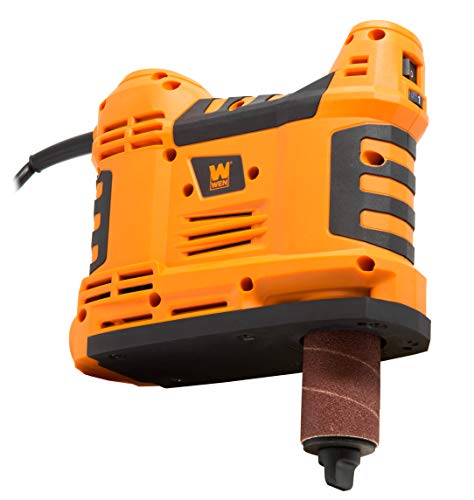 WEN HA5932 5-Amp Variable Speed Portable Oscillating Spindle SanderCheck Amazon offer
Documented specifications for WEN HA5932
| Model | Family | Sleeve height (in) | Diameters (in) | Belt size | Table tilt | Offer |
|---|---|---|---|---|---|---|
| WEN HA5932 | portable | 3 | 0.5, 0.75, 1, 1.5 | None documented | Not confirmed | Check Amazon offer |
- Machine weight
- 5 lb
- Documented spindle speed
- 1800 / 3200 RPM
- Dust port
- 1.5 in
3 in. is documented drum length; verify replacement sleeve fit with WEN 5932SPC.
US 120V documentation.
Bring the abrasive to the work
WEN supplies four sleeve diameters, from 1/2 to 1-1/2 inches, and describes a variable range of 1800 to 3200 RPM with 50 to 90 oscillations per minute. The manual lists a 3-inch drum length and a 5-pound product weight. The modest maximum diameter makes the HA5932 especially worth considering for access questions rather than simply treating it as a miniature replacement for every benchtop job. Before deciding, inspect where the motor housing, your hands, and the dust hose would sit around the intended cutout. A sleeve fitting into an opening is only one part of usable tool access.
Handheld work shifts the support problem
On a normal spindle table you move the material past a supported abrasive. In handheld use, the material must remain securely held while you control the tool. Plan clamping so the blank cannot rotate or flex when pressure changes. Arrange supports close enough to the working region that a thin panel does not bounce, but keep clamps outside the intended travel path. On a long inside edge, establish how you will change stance without losing orientation. This is particularly relevant when refining openings in an assembled component: access can be better, yet visibility and a repeatable edge angle can be harder to maintain than on a flat bench.
Use speed as a controlled variable
A speed dial adds flexibility, but it does not select the correct setting for you. Start from the material and abrasive guidance in the manual, then evaluate representative scrap before touching the final component. Keep the contact pressure and movement reasonably consistent while comparing settings; otherwise the result cannot tell you whether speed caused the difference. If the abrasive loads rapidly or the wood darkens, pause to inspect the sleeve and technique instead of assuming the fastest setting is desirable. Rotation and oscillation change together within the published ranges, so they are not independent controls that can be tuned separately for an experiment.
The clamped configuration has its own footprint
WEN includes clamps and a mounting pad for converting the tool into a stationary setup. Treat that as a specific approved configuration, not an invitation to improvise a mounting arrangement around the housing. Read the setup sequence and confirm the bench edge and clamp reach are suitable. A small tool still needs stable work support and clear hand access. For a long curved rail, the practical support problem may dominate the saved footprint. Compare this arrangement with a full benchtop table using an actual project blank or a cardboard outline. That quick planning exercise can reveal awkward tipping points before a purchasing decision.
Keep the shorter consumables distinct
The HA5932 product page identifies WEN 5932SPC replacement sleeves as compatible. This explicit model relationship is useful because diameter sizes overlap with larger sanders whose abrasives may have a different height. Store portable-tool sleeves separately from any 4-1/2-inch assortment in the shop, and label the container with the exact machine model. WEN gives a 1-1/2-inch dust port; check the fitting and hose flexibility as well as nominal size. Check hose weight as part of handheld control: the connection should not pull the tool away from the intended edge. Plan extraction and cable routing alongside the tool, rather than after the workpiece is already clamped.
Make a hose routing rehearsal
Before handheld work with the HA5932, rehearse the intended travel with the machine unplugged and the hose connected. Look for moments when the hose changes direction abruptly or rests on a finished face. Rearranging the work supports or extraction position before sanding can prevent interruptions halfway through a visible edge, when maintaining a consistent tool orientation is especially valuable.
Check access and support before choosing the HA5932
Before choosing the HA5932, confirm that the workpiece can be secured, the housing and hose can follow the intended edge, and four diameters through 1-1/2 inches cover the curves. Stop and compare a fixed benchtop sander when a stable table makes loose parts easier to guide, the AT6535 when a supported bevel is required, or the 6524 when a straight sanding belt is part of the same workflow. The included clamps and non-marring pad define WEN's stationary arrangement; they do not authorize an improvised mount.
WEN publishes 1,800-to-3,200 RPM, 50-to-90 oscillations per minute and a 1/4-inch stroke for this portable model. The controls do not make rotation and oscillation independently adjustable. The linked Amazon listing is matched to HA5932; replacement sleeves should remain tied to WEN's explicit 5932SPC relationship rather than inferred from diameters shared with taller bench-machine sleeves.
Questions about WEN HA5932 Spindle Sander Guide
Can the HA5932 be used on a bench?
Yes. WEN describes a stationary arrangement using its supplied clamps and non-marring mounting pad. Follow that arrangement in the operator manual rather than devising an unsupported mounting method.
Will my larger WEN sander sleeves fit?
Do not assume so. The HA5932 uses a shorter drum format, and WEN explicitly identifies its 5932SPC replacement pack. Match the complete sleeve specification and model fit, not just diameter.
Is portable always better for large parts?
No. It can make the edge accessible, but you must still secure the part and control the tool orientation. For loose parts that sit flat and move easily, a benchtop support surface may simplify the task.