brands
Ryobi OSS450 Spindle Sander: Legacy Model Guide
The documented legacy Ryobi oscillating spindle sander is model OSS450, not OSS500. Ryobi operator's manual 972000-237 identifies the OSS450 and supplies exact historical specifications for that machine. This guide corrects the earlier model-name error and helps a used buyer separate plate identity, sanding dimensions, loose accessories and condition. It does not establish current Ryobi production, new stock, replacement-part availability or an exact Amazon offer.
As an Amazon Associate I earn from qualifying purchases. How affiliate links work.
No exact Ryobi OSS450 Amazon offer was matched. The offers below are clearly labeled current alternatives, not Ryobi parts or model-equivalent substitutes.
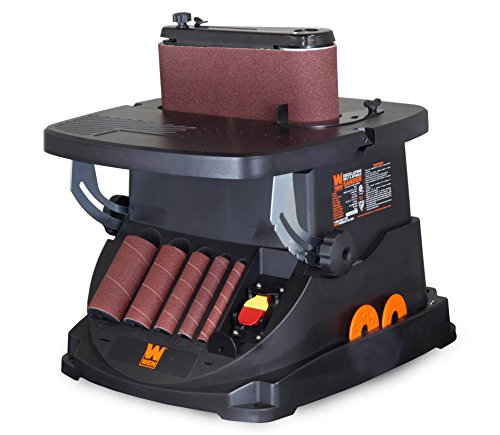 WEN 6524 Oscillating Belt and Spindle SanderCheck Amazon offer
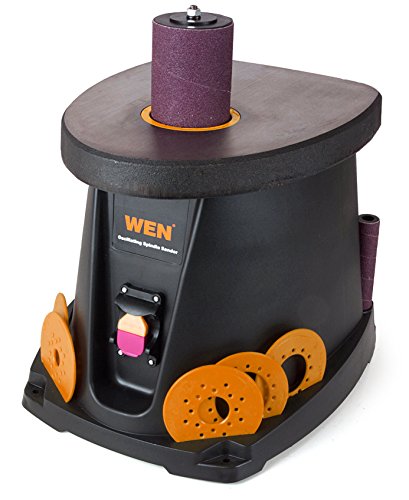 WEN 6510T 3.5 Amp Oscillating Spindle Sander,BlackCheck Amazon offer
Confirm OSS450 on the plate and manual
The preserved original manual names model OSS450, carries manual number 972000-237, and is marked as printed in November 2000. It identifies a double-insulated 120-volt, 60-hertz AC machine rated at 3.5 amps. Those facts correct the former OSS500 label on this page; they do not apply automatically to a different Ryobi tool. Ask for a clear rating-plate photograph and compare it with the manual before using these values for installation, parts or operating decisions.
Keep three sanding dimensions separate
The manual lists a sleeve capacity from 1/2 inch through 3 inches, a sanding height of 4-1/2 inches, and a sanding thickness of 3-11/16 inches. These are different constraints. Sleeve capacity is the documented abrasive-diameter range; sanding height describes the abrasive working height; sanding thickness is the stated workpiece limit. Do not turn the 4-1/2-inch figure into a thickness claim or infer that any sleeve with a nominal diameter in the range will assemble correctly without the matching drum, washer and table insert.
Use motion, table and extraction facts as identifiers
The OSS450 manual specifies 2,000 spindle revolutions per minute, 58 oscillations per minute and a 5/8-inch oscillating range. It lists a 20-by-14-inch table, a 2-1/4-inch dust outlet and a machine weight of 26 pounds. These values help distinguish the exact legacy model and plan a station, but they are not performance rankings. A dust-port diameter does not prove that an arbitrary hose or adapter fits securely, and the table dimensions do not establish safe support for every workpiece. Use the manual's setup and operating instructions for the actual machine.
Inventory the loose components
Lay out the drums, sanding sleeves, inserts, washers and supplied tools beside the machine, then compare them with the OSS450 manual. An owner may have stored small pieces elsewhere or mixed them with another sander's accessories. One installed drum does not prove the remaining diameters can be assembled. Missing abrasive paper may be replaceable after exact measurement; missing model-specific hardware is a different problem. Use the sleeve Finder only as a documented-dimension lookup, not as certification that a generic assembly will fit.
Inspect operation as well as appearance
An appropriate demonstration should show the spindle's intended rotation and oscillation, along with normal controls and a properly assembled sanding configuration. Listen and observe from a safe position rather than reaching toward a running machine. A video cannot prove the condition of every internal component, but it can answer more than a still photograph of a clean tabletop. Ask about repairs, modifications, storage conditions, and any faults the seller knows about. If electrical damage or unexplained modifications are present, obtain qualified assessment before use instead of turning an uncertain purchase into an improvised repair.
Do not infer current production or support
A preserved manual proves the OSS450's historical identity; it does not prove current production, authorized new stock, repair feasibility or a stocked replacement-part line. Used advertisements and owner discussions can remain visible for years. Ask Ryobi support or a suitable parts source about the exact model and component number, and keep that answer separate from the seller's description. If a required part remains unidentified or unavailable, price the machine as an unresolved repair rather than assuming a similar-looking generic component is suitable.
Make the used-buying decision explicit
Write down what must be true for an OSS450 to be worthwhile: confirmed plate identity, complete required hardware, acceptable condition, available consumables and a realistic service path. Add transport and known repair requirements. If one essential item remains unresolved, compare a documented alternative before committing. Use the used-machine inspection guide and model-specific parts guide to keep identity and repair questions explicit. The manual supports historical model facts; current availability and the seller's claims require separate evidence.
Questions about Ryobi OSS450 Spindle Sander: Legacy Model Guide
Did Ryobi make an OSS450 spindle sander?
Yes. Original operator's manual 972000-237 documents the Ryobi OSS450 oscillating spindle sander.
Does this guide confirm a new Ryobi range today?
No. It addresses the legacy OSS450 and does not establish current production, new stock or current parts support.
Can a similar-looking generic drum be assumed to fit?
No. Verify the dimensions and mechanical compatibility against the exact manual or a confirmed parts reference.