buying guides
Portable Spindle Sanders: Handheld or Movable Benchtop?
Portable can describe two different purchases: a benchtop sander you can move between sessions, or a purpose-built handheld spindle sander that moves across a secured workpiece. The difference changes the technique, support, and space you need. Decide which kind of portability solves your problem before comparing motor ratings or carry weight. A portable label is not permission to improvise another operating configuration.
As an Amazon Associate I earn from qualifying purchases. How affiliate links work.
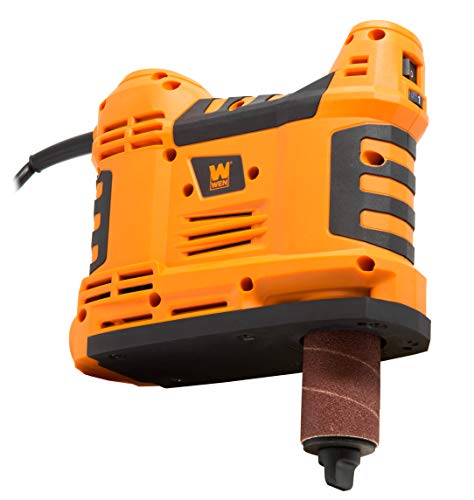 WEN HA5932 5-Amp Variable Speed Portable Oscillating Spindle SanderCheck Amazon offer
 Triton TSPSP650 650W Portable Oscillating Spindle SanderCheck Amazon offer
Decide which object needs to move
For a manageable wooden bracket, keeping the tool fixed while moving the part over a table may provide the most useful support. For a large installed panel or an awkward opening, bringing a suitable handheld tool to the work may be more practical. The workpiece still needs to be secure and the operation must be approved by the tool manufacturer. Do not assume that a compact bench machine is intended for handheld use simply because you can lift it.
Use a purpose-built example to define the category
Triton's TSPSP650 is a documented portable oscillating spindle sander, distinct from the company's TSPS450 benchtop model. The Triton family guide keeps the portable, stationary and belt-and-spindle identities separate. WEN's HA5932 guide documents another purpose-built portable/clamped arrangement. These examples are relevant because their manufacturers designed and documented those uses, not because the same result can necessarily be achieved by turning a different sander over or attaching it to an improvised support.
Evaluate moving a benchtop machine honestly
If portability means carrying a bench sander from storage, check machine weight, available lifting provisions, storage height, and the route to the bench. Account for protruding storage racks, loose sleeves, and a detachable hose. A machine that is manageable once may still be unpleasant to move every weekend. Plan how it will be secured when in use. Setting a sander on a smooth counter for convenience does not establish that it has the stability required by its installation instructions.
Think about contact and visibility on large parts
When the tool moves, seeing the layout line and keeping the contact angle consistent become central considerations. The operator must avoid rounding an edge unintentionally while following the contour. Look for a manufacturer-approved working arrangement that supports the tool for your application. If the location blocks clear access, a powered spindle may be less suitable than another method. Portability is valuable only when it improves access without trading away the support and control needed to preserve the shape.
Bring dust control into the portability plan
A lightweight tool connected to an awkward hose is not a complete portable system. Check the extraction connection, hose flexibility, power lead routing, and the clearance around the opening or edge. The hose should not snag on corners or pull the tool off its intended path. For a movable bench unit, keep the required adapter with the machine so setup stays repeatable. Evaluate the extractor as part of what must travel, especially if the work occurs away from your main workshop.
Buy for the recurring transport situation
Write down where you will use the tool most often and what you must carry to get there. For occasional home-shop curves, a movable benchtop machine may be enough. For repeated work on large secured pieces, a purpose-built portable model deserves investigation. For continuous precision edge work, a permanent station may offer a more convenient process. Compare the whole kit, the available work support, and the approved setup. Weight alone cannot decide which approach makes the finished edge easier to control.
Check portability against two pieces: a loose bracket and a large secured panel with an opening. The bracket can move over a properly mounted bench sander, whereas the panel may call for a documented handheld spindle tool. For the panel, verify the approved operation and tool support before comparing weight. In either case, the useful arrangement keeps the work secure and allows the abrasive to follow the intended edge.
Questions about Portable Spindle Sanders: Handheld or Movable Benchtop?
Is a portable spindle sander the same as a small benchtop model?
Not necessarily. Some tools are designed for handheld work, while others are compact machines that still require secure bench installation. The manual defines the allowed configurations.
Can I invert a handheld tool to make a bench sander?
Only use a stationary configuration explicitly approved by the manufacturer with the specified mounting equipment. Do not infer approval from a flat housing or an aftermarket idea.
Does variable speed make a portable model better?
It can be useful within the tool’s approved applications, but it does not replace secure workholding, suitable abrasives, and controlled contact. Select by the actual task and documented operating method.