guides
How Does a Spindle Sander Work?
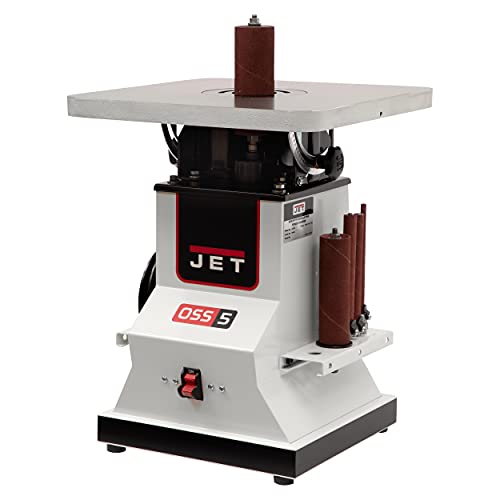
A spindle sander removes material when abrasive grains on a rotating sleeve pass across the edge of a workpiece. The worktable supplies support while the operator controls the path and contact pressure. On an oscillating model, the sleeve also travels vertically, distributing contact over more of its height. These movements explain both the machine’s usefulness and its limits: it follows the contact you create, so a steady motor cannot compensate for an uneven feed path or an unsupported part.
As an Amazon Associate I earn from qualifying purchases. How affiliate links work.
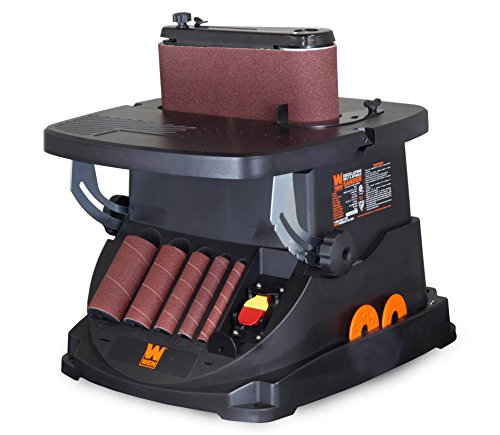 WEN 6524 Oscillating Belt and Spindle SanderCheck Amazon offer
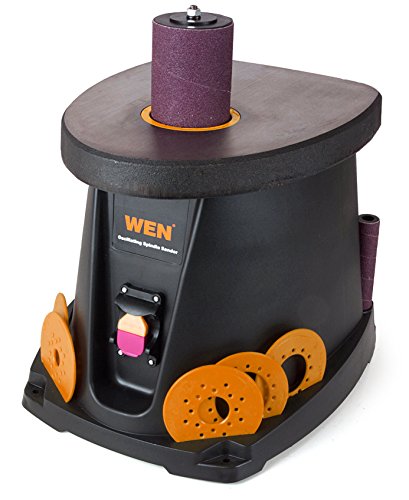 WEN 6510T 3.5 Amp Oscillating Spindle Sander,BlackCheck Amazon offer
Rotation does the cutting
The circular motion repeatedly brings abrasive grains into contact with the work. Those grains scratch and remove tiny amounts of material. The outline changes where contact occurs, rather than across the whole board at once. This is why lingering at one point can make a dip while the surrounding edge remains untouched. Think of the sleeve as a local cutting surface. The task is to move that local contact along a planned boundary, preserving the relationship between adjacent portions of the curve instead of judging each spot independently.
Oscillation changes the contact band
Vertical travel shifts which portion of the sleeve meets a given edge. JET describes this combined motion as a way to spread abrasive use and reduce grooving. It is helpful, but it does not make poor feed technique harmless. A stationary workpiece still exposes the same area of wood to continuing abrasion. The machine may distribute wear on its sleeve while removing too much wood from one point. Use oscillation as a feature that supports an appropriate sanding process, not as a reason to press harder or remain in one position.
Diameter changes the geometry
A smaller drum reaches a tighter concave radius, whereas a larger one presents a flatter local arc. At equal rotational speed, different diameters also have different surface speeds because their circumferences differ. That relationship helps explain why sleeve changes can alter the feel of the cut even when the motor setting has not changed. It does not supply a universal speed recommendation. Follow the permitted assemblies and settings for the specific machine, then evaluate a representative offcut rather than transferring a technique blindly between diameters and materials.
The table establishes a reference
A flat, stable face against the table helps maintain the intended edge angle. If the board rocks on debris or a distorted face, the abrasive may contact the top and bottom of the edge differently. The resulting bevel can be mistaken for a spindle alignment problem. Before blaming the mechanism, inspect the support conditions with the machine isolated from power. A tilting table intentionally changes the edge angle, but the angle scale is still something to verify against the project requirement. An accurate table setting still depends on the board resting steadily against that table.
Abrasive condition changes the process
Fresh, appropriate abrasive cuts differently from a sleeve filled with compacted dust or resin. When removal slows, additional pressure can hide the original problem while increasing heat and reducing control. Examine the stopped sleeve and the pattern of marks on the work. A localized polished band suggests that part of the abrasive is doing more work than the rest. A torn or loose sleeve requires correction before further operation. If the motor runs normally but the edge barely changes, check abrasive wear, loading, and sleeve installation before pursuing a motor fault.
Use the mechanism to diagnose results
A repeated defect carries information. A dip at one section of an outline points toward the feed path or dwell time. A changing bevel suggests support or table alignment. A sleeve that spins but no longer travels vertically points to a different class of mechanical fault. Record what happens before adjusting anything, then change one relevant condition at a time. The troubleshooting section of your model manual determines which inspections belong to an owner and which require service. Do not expose moving drives or defeat covers simply to watch the mechanism run.
Questions about How Does a Spindle Sander Work?
How does a spindle sander work?
A rotating abrasive cylinder removes material from a supported edge. Oscillating versions also move the cylinder vertically to spread contact over the sleeve.
Does oscillation replace moving the wood?
No. The work still needs a controlled feed path. Holding one spot against the sleeve can alter the shape even while the sleeve oscillates.
Does a larger spindle remove more wood automatically?
No. Diameter changes access and contact geometry, but removal also depends on abrasive, material, pressure, and dwell time.