guides
Which Way Does a Spindle Sander Spin?
The correct rotation direction is the one specified for your exact spindle sander; verify the arrow and manual rather than assuming every model is identical. The important operating relationship is to feed the work against the abrasive’s motion at the contact point, as directed by the manufacturer. A blanket instruction such as move left to right can become misleading when the work moves to another side of the spindle or surrounds it inside an opening.
As an Amazon Associate I earn from qualifying purchases. How affiliate links work.
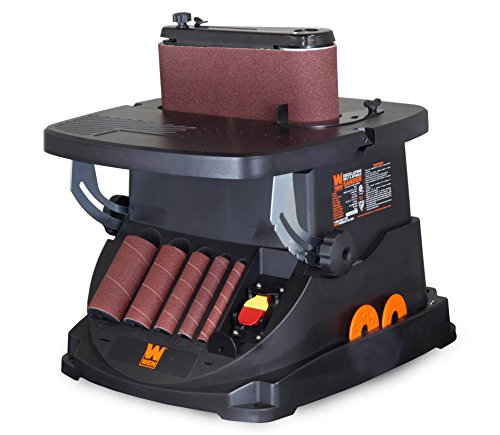 WEN 6524 Oscillating Belt and Spindle SanderCheck Amazon offer
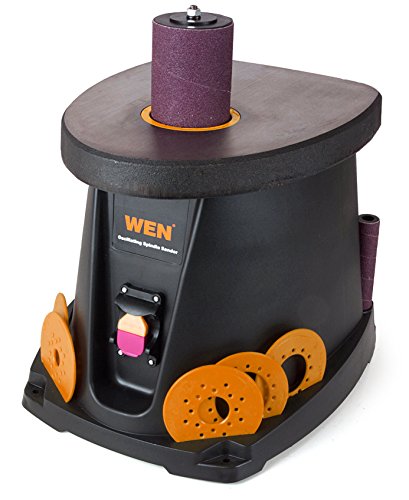 WEN 6510T 3.5 Amp Oscillating Spindle Sander,BlackCheck Amazon offer
Separate rotation from feed
Rotation describes the spindle turning around its axis. Feed describes the workpiece moving relative to the abrasive. They are related but are not the same direction label. A clockwise spindle has abrasive moving one way at its front and the opposite way at its rear. Consequently, the same left-to-right hand movement can oppose the abrasive at one location and follow it at another. The Grizzly manual specifies feeding against drum rotation. Use the actual contact location and the model's instructions to translate that relationship into the movement required for your setup.
Locate the point that is doing the sanding
On a broad concave shape, the apparent contact may span an arc. On a nearly straight edge, the contact is more localized. Before operating, identify which portion of the sleeve the work is intended to meet. Do this during a power-isolated rehearsal rather than experimenting with a live part. If the work would contact multiple opposing areas of the sleeve or become trapped around it, choose a smaller permitted assembly or another process that provides workable clearance. Leave enough clearance to guide the edge without trapping the blank against the sleeve.
Reconsider direction inside an opening
An internal cutout places the spindle within the blank, so the contact point changes as the part moves. It is easy to carry over a hand motion learned while sanding an outside edge and apply it without checking the local abrasive motion. Plan the sequence around the opening in advance. Keep the blank supported and ensure its perimeter has room to move. If you cannot follow the required feed while maintaining control and clearance, stop and revise the operation. The solution is not to accept an uncontrolled self-feeding movement because the remaining area is small.
Do not use grain as an override
Grain orientation can affect the appearance of an edge, especially near fragile points or changing grain. It does not justify reversing the manufacturer-prescribed feed relationship. If the required feed produces unacceptable fibers or risks damaging a delicate feature, change the preparation, use an appropriate abrasive, or finish that portion by another suitable method. Distinguish a cosmetic concern from the control requirements of the machine. A hand-sanding block can be moved with the grain without introducing the same rotating-tool feed problem, making it useful for selective final refinement.
Investigate unexpected rotation
A machine that appears to rotate differently from its manual or marked arrow should be taken out of service until the discrepancy is resolved. Confirm the model, revision, and viewing direction first; a label can be misread when comparing a top view with a side illustration. Do not alter wiring or interchange connections as an improvised correction. Contact the manufacturer or a qualified service provider with the machine identification and a clear description of the observation. A direction question can indicate a documentation mismatch, but it can also indicate a condition requiring professional attention.
Build a reliable preflight habit
For each new setup, ask three questions: where is contact, which way does the abrasive move there, and what supported path opposes that motion? Repeat this assessment when changing from an outside profile to an inside opening or when changing the orientation of a complex blank. Check those three points again whenever the contact moves to another side of the spindle. Follow the actual model's diagram and training requirements. A correctly understood feed direction supports control, while the rest of the operation still depends on suitable work size, hand clearance, support, and properly installed accessories.
Questions about Which Way Does a Spindle Sander Spin?
Which way does a spindle sander spin?
Check the exact machine’s arrow and manual. Do not assume the rotation direction from another model or from an ambiguous camera view.
Do I always move the board left to right?
No. The correct feed depends on the contact point around the sleeve. Follow the manufacturer’s instruction to oppose abrasive motion at that point.
Can I reverse feed to follow the grain?
Do not override the prescribed machine feed. Use a suitable alternative finishing method if the safe feed direction does not produce the desired surface.