guides
Is a Spindle Sander Worth It for Your Workshop?
A spindle sander is most likely to be worth buying when curved-edge cleanup is a regular part of your work and the machine fits those parts comfortably. It is less compelling for a shop focused almost entirely on straight panels or occasional delicate repairs. A useful purchase decision includes time, space, support, extraction, and consumables. Motor specifications alone do not tell you whether the machine will improve your workflow. Start with the work you expect to repeat, then compare complete ways of doing it.
As an Amazon Associate I earn from qualifying purchases. How affiliate links work.
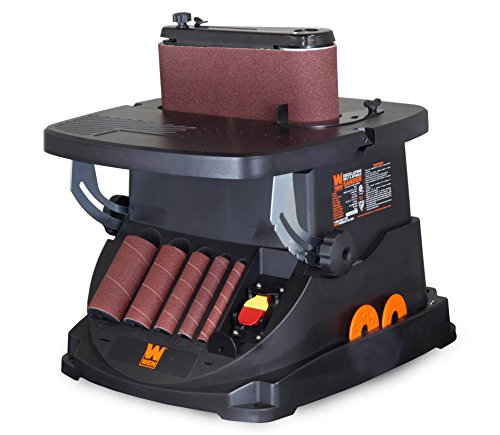 WEN 6524 Oscillating Belt and Spindle SanderCheck Amazon offer
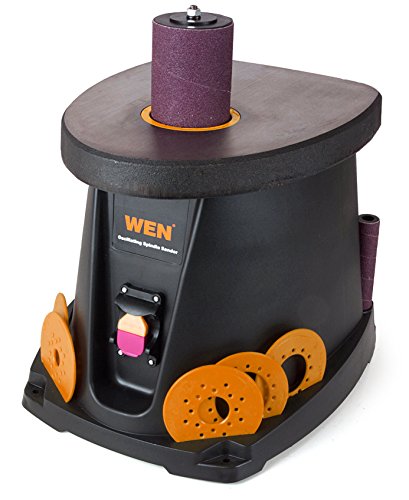 WEN 6510T 3.5 Amp Oscillating Spindle Sander,BlackCheck Amazon offer
Identify a real bottleneck
Review a handful of recent or planned projects. Record the operations that involved curved edges and what made them slow: removing saw marks, fairing an outline, reaching a hollow, or correcting a poor rough cut. A spindle sander may address the first three, but it can also become an expensive way to compensate for avoidable preparation problems. If better cutting would eliminate most of the sanding, that improvement deserves consideration. The strongest purchase case is a repeated operation that remains necessary even after the earlier steps are performed competently.
Count the entire setup
For a tool stored under a bench, the working time includes lifting or moving it safely, securing it, connecting extraction, selecting a sleeve, and clearing enough table space. For a permanently installed machine, the space has an ongoing opportunity cost. Neither arrangement is automatically preferable. Consider how often the tool will be used and whether it can be brought into service without disrupting another essential station. A purchase that looks efficient in a demonstration can be inconvenient in a compact room if every use requires dismantling the existing work area.
Compare outcomes as well as minutes
A smoother edge is valuable only if the required shape survives. When evaluating a new method, compare the completed part with the drawing or mating component. Consider repeatability, scratch removal, retained dimensions, and time spent repairing mistakes. Do not treat abrasive marks removed per minute as the sole measure. For example, a hand block might be slower but preserve a fragile detail more reliably. Conversely, a supported machine setup may make repeated broad curves easier to manage. Compare the time needed to produce an acceptable part, including any correction after sanding.
Include the accessories you will actually use
A machine may arrive with several diameters but only one grit in each. Your workflow may require additional sleeves, a compatible extraction hose or adapter, a mounting solution, and replacement inserts. Verify what is included instead of assuming product photographs represent the delivered kit. Check that replacement sleeves in the needed dimensions are readily identifiable. WEN's combination machine listing illustrates why configurations should be compared explicitly: a belt-and-spindle unit offers an additional function, but that function has value only if it solves another real task in your shop.
Consider access before ownership
An occasional project may be better served by a shared workshop, a class facility, or an existing suitable hand technique. Access arrangements still require training and permission, and availability may be inconvenient, but they allow you to learn whether spindle sanding addresses your actual work. If you can try an appropriate machine, use a representative scrap and evaluate the result honestly rather than assuming a brief demonstration proves long-term productivity. Use your own setup, sanding, and rework times to estimate the purchase's payback; a brief demonstration cannot supply those figures.
Set a decision rule
Choose a practical trigger such as several upcoming projects with substantial concave edges, suitable material dimensions, and a permanent place for the tool and extraction. Then compare candidates against that requirement. If no candidate supports the necessary parts or sleeves, postponing the purchase is a rational outcome. If several do, use our best-spindle-sander buying guide to compare documented specifications and tradeoffs. Separate must-have capabilities from pleasant extras. A clear requirement makes it easier to avoid paying for capacity you will not use or accepting a limitation that will affect every project.
Questions about Is a Spindle Sander Worth It for Your Workshop?
Is a spindle sander essential?
No. It is a specialized edge-sanding tool whose value depends on how often you make compatible curves and openings.
Will it save time?
It can, but include preparation, mounting, sleeve changes, extraction, cleanup, and any rework when comparing methods.
Which spindle sander is best?
There is no universal winner. Compare your required radii, work size, extraction, and budget in the best-spindle-sander buying guide.