guides
When to Use a Spindle Sander
Use a spindle sander when an accessible curved edge needs controlled cleanup and the workpiece can remain securely supported on the table. It is particularly useful for inward curves after sawing. Choose a different method when the job is primarily flattening a face, establishing uniform thickness, forming a sharp internal corner, or handling a piece too small to control. The decision is about the contact needed and the support available, rather than whether the material can physically touch an abrasive cylinder.
As an Amazon Associate I earn from qualifying purchases. How affiliate links work.
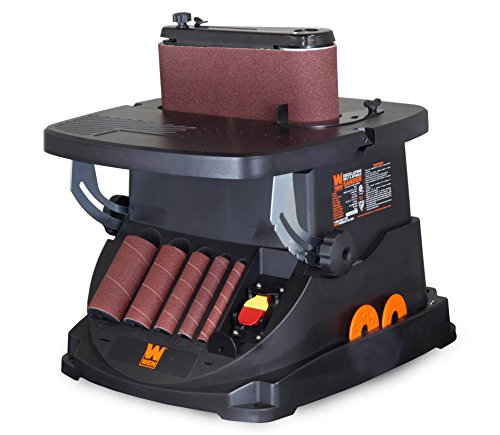 WEN 6524 Oscillating Belt and Spindle SanderCheck Amazon offer
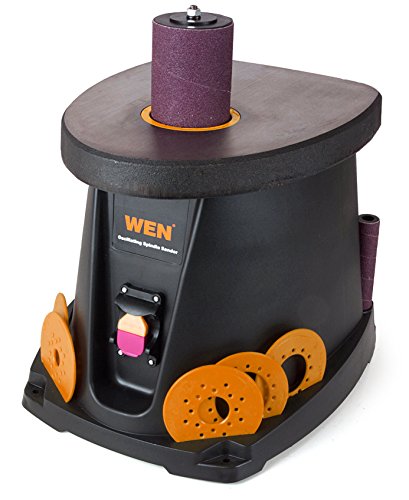 WEN 6510T 3.5 Amp Oscillating Spindle Sander,BlackCheck Amazon offer
Ask what must change
Write the desired change in plain language before selecting a tool. Remove saw marks from an arch is a different task from make two faces parallel. The first calls for contact along a curved edge; the second requires control across a surface and between opposing faces. Similarly, smooth a drilled opening does not necessarily mean make that opening accurately round. Choose the process that controls the required feature: an outline, a pair of faces, or a fitted opening. When shape and dimensions both matter, establish which feature must remain fixed while the other is refined.
Check the smallest radius
A concave curve has to accommodate the sleeve without trapping the work against a broad arc of abrasive. Look at the tightest part of the outline rather than its average curvature. A sleeve suited to a large hollow may not enter the transition at either end. Changing to a smaller diameter can improve access but also concentrates contact, demanding more attention to the line. If the intended outline contains a truly square interior corner, cylindrical sanding alone cannot reach it. Reserve that detail for a method that matches the required corner geometry.
Evaluate the complete workpiece
Table support should be assessed with the whole blank, not just the edge being sanded. A long overhang can create leverage that rocks the face away from its reference. A narrow bridge around a cutout can flex. A warped board can rest differently as it turns. With power disconnected, rehearse the range of movement and identify any point at which support or hand placement becomes awkward. This rehearsal is a planning aid, not approval for an improvised fixture. If control cannot be maintained, reconsider the blank size, sequence, or method.
Use it after sensible rough preparation
A spindle sander usually makes more sense as a refinement step than as the way to remove a large block of waste. Sawing close enough to the intended profile reduces sanding time and keeps heat and abrasive consumption manageable. Leave enough allowance to remove cutting defects without crossing the final line. The appropriate allowance depends on the cut and the material; there is no single universal distance. Keep that allowance reasonably even around the curve. A relatively even margin permits a continuous sanding path instead of repeated long pauses at isolated heavy sections.
Know when hand sanding is the better choice
Manual sanding can offer better control near fragile details, a thin decorative surface, or a final dimension with little remaining allowance. A shaped sanding block can preserve a particular radius, while a flat block can protect a straight reference. Hand sanding is also a reasonable answer for a rare task that does not justify machine setup. Compare the full operation: preparation, extraction, sleeve selection, cleanup, and risk of rework. A machine that removes material faster at the point of contact does not necessarily finish a one-off project sooner overall.
Make the decision repeatable
Create a brief project note recording the material, minimum inside radius, thickness, support face, desired finish, and tolerances. After the job, record whether the chosen method preserved those requirements. Over several projects this becomes a better basis for purchasing equipment than a general claim that every woodworker needs a spindle sander. CCOHS emphasizes understanding a sander's applications and limitations before use. Apply that idea to each operation: confirm the machine fits the task, then use the model manual to determine the permitted setup and operating procedure.
Questions about When to Use a Spindle Sander
When spindle sander?
Use one for supported curved-edge cleanup, particularly concave shapes, when an approved sleeve fits and the work can be controlled.
When to use a spindle sander instead of a random-orbit sander?
Choose the spindle for accessible inward edges. A random-orbit sander is generally more relevant to broad faces, subject to the work and tool instructions.
Can I use it for a single small project?
Possibly, but a suitable hand method may involve less setup and better control. Evaluate the complete job rather than removal speed alone.