guides
What Is a Spindle Sander? Uses and Basic Parts
A spindle sander is a power tool that sands with a cylindrical abrasive sleeve standing above a worktable. You guide a supported workpiece against the sleeve to refine an edge, especially an inward curve that a flat sanding surface cannot reach. Many dedicated models also move the sleeve up and down as it spins. That additional movement is called oscillation. The machine is a shaping and edge-finishing tool; choosing it begins with the geometry of the project rather than the size of its motor.
As an Amazon Associate I earn from qualifying purchases. How affiliate links work.
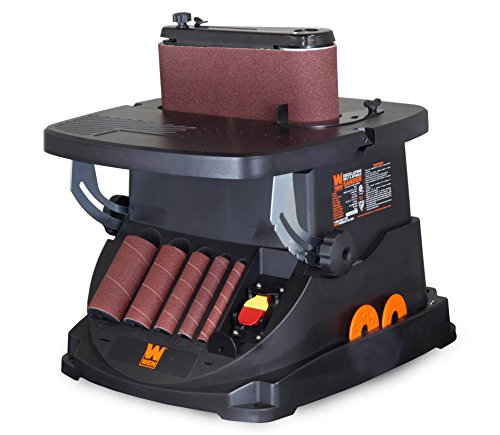 WEN 6524 Oscillating Belt and Spindle SanderCheck Amazon offer
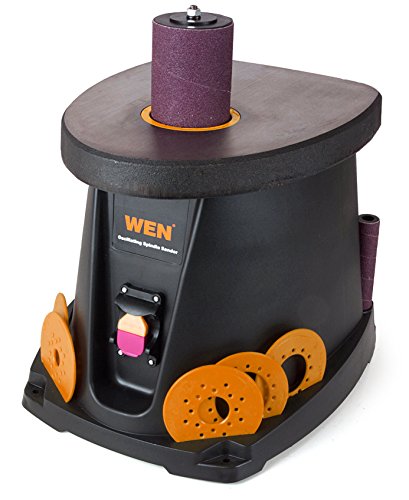 WEN 6510T 3.5 Amp Oscillating Spindle Sander,BlackCheck Amazon offer
Start with the contact surface
Imagine the inside edge of an arch cut from a board. A flat sanding block touches the high spots but cannot follow a tight hollow evenly. A cylinder can enter that hollow and present abrasive directly to the curved edge. Changing cylinder diameter changes which curves are accessible. A sleeve much smaller than the intended curve can still remove material, but its small contact area makes it easier to create a hollow in one place. A larger sleeve that fits comfortably usually provides a more manageable contact area for a broad curve.
Recognize the parts before buying accessories
The spindle is the shaft; the sanding sleeve is the replaceable abrasive cylinder. Many sleeve sizes fit over rubber drums, while some machines mount their smallest sleeve directly on the shaft. The table supports the work and the insert closes the opening around the selected assembly. Match the drum, sleeve, insert, and retaining hardware to the assembly specified for that diameter. For assembly details, consult the exact model manual. The Grizzly manual linked below provides one manufacturer example; its hardware arrangement should not be assumed to describe every sander sold under this category.
Separate shape from surface finish
There are two jobs hidden in the word sanding. Shaping removes enough material to change the outline. Refining removes the scratches left by earlier cutting or sanding. A spindle sander can perform both jobs on an accessible edge, but the correct stopping point differs. During shaping, compare the outline with a drawn line or template. During refinement, look for a consistent scratch pattern without allowing the dimensions to drift. A smooth edge can still be the wrong shape, so touch alone does not establish that a part is finished.
Understand the boundaries of the tool
The table gives a useful reference for holding a supported board at a repeatable angle. It does not automatically make the board flat, establish parallel thickness, or turn a hand-guided circle into a precision bore. Broad faces generally call for other sanding equipment. Tiny pieces, deeply enclosed cavities, and work too tall for the useful sleeve height raise different access and holding problems. If the project cannot remain adequately supported while keeping hands clear, the presence of an abrasive that fits the curve is not enough to make the operation suitable.
Decide whether your projects have the right geometry
A useful first exercise is to list the edges you actually make: curved brackets, shaped furniture parts, scroll-cut openings or templates. The oscillating-spindle-sander uses guide owns those project examples. If the phrase sanding spindles instead means stair balusters or turned chair parts, use the separate turned-spindle guide rather than assuming this stationary machine is the default tool. That distinction keeps the machine definition separate from a different workpiece intent.
Separate project plans from machine-building plans
Spindle sander plans can mean plans for a woodworking project that uses the machine or plans for building the sanding mechanism itself. For a project such as a curved bracket, template, or supported interior opening, start with the smallest inside radius, workpiece support, and the exact machine's documented sleeve assemblies. A project plan does not establish that an arbitrary sleeve, drum, or holding method is suitable.
This guide does not provide homemade motor, arbor, wiring, guarding, or oscillation-conversion instructions. A cabinet, stand, or dust enclosure around a manufacturer-approved machine is a different project from constructing or modifying the rotating mechanism. Chuck fit or a home-built table does not establish that a drill press, router, or lathe is approved for side loading, a sanding drum, or an improvised guard. The spindle-sander versus drill-press guide explains that decision boundary, and the drill sanding-drum guide treats an attachment as compatible only when the host tool's exact instructions allow the setup. Use a purpose-built machine and its manual, or have a qualified machine-safety professional review a proposed design.
Read product language carefully
Oscillating spindle sander, benchtop spindle sander, and belt-and-spindle sander describe overlapping but different features. Oscillating describes motion. Benchtop describes mounting and scale. A combination machine adds another sanding arrangement that requires its own setup. Manufacturer listings from JET and WEN illustrate those distinctions. Compare usable sleeve height, supported diameters, table adjustment, extraction connection, and replacement-part availability. None of those features alone establishes finish quality. In practice, the result also depends on the cut left before sanding, the abrasive condition, and the care taken to preserve the intended outline.
Questions about What Is a Spindle Sander? Uses and Basic Parts
What is spindle sander?
It is a sander with a cylindrical abrasive sleeve, usually mounted vertically through a support table, for refining curved edges and openings.
What is a spindle sander good for?
Its strongest application is controlled sanding of accessible concave edges. It also refines outside curves, shaped parts, and some interior cutouts.
Is a spindle sander the same as a drum sander?
The names can overlap informally, but a thickness drum sander feeds broad boards beneath a horizontal abrasive drum. A spindle sander shapes edges around a vertical sleeve.
Can you make a DIY spindle sander?
This site does not provide plans for a homemade sanding mechanism or a drill-press, router, or lathe conversion. Rotating hardware, guarding, work support, speed, extraction, and electrical suitability require a documented purpose-built design or review by a qualified machine-safety professional.