guides
Spindle Sander Material Limits and Unsuitable Jobs
A spindle sander’s limitations come from more than motor power. The material must be permitted, the shape must fit an approved sleeve assembly, and the work must remain supported and controllable. A piece can be small enough to reach the abrasive yet still be unsuitable to sand. Use the exact manual to establish allowed applications, then examine the actual workpiece. Check material permission, sleeve clearance, and supported travel separately before deciding the operation is suitable.
As an Amazon Associate I earn from qualifying purchases. How affiliate links work.
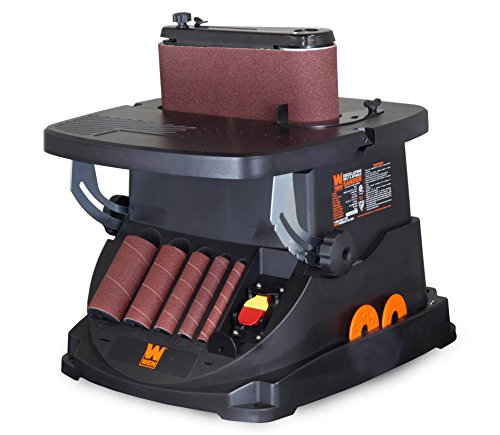 WEN 6524 Oscillating Belt and Spindle SanderCheck Amazon offer
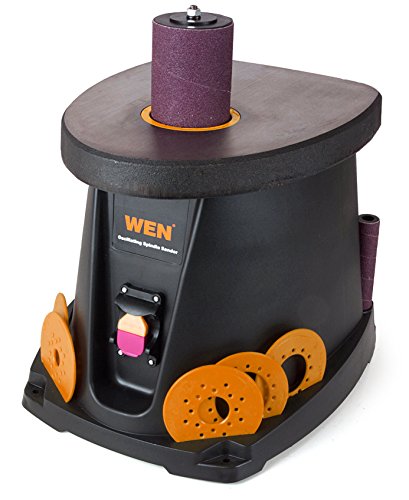 WEN 6510T 3.5 Amp Oscillating Spindle Sander,BlackCheck Amazon offer
Permission comes before experimentation
Read the machine's intended-use statement and material restrictions. Do not assume that all abrasives permit sanding wood, plastic, metal and composites interchangeably. A material can introduce heat, dust or spark conditions outside the tool and collector design. The plastic-specific guide explains the additional material-supplier and heat checks; it does not turn an undocumented plastic into an approved use. When the intended material is unsupported, consult the manufacturer or choose a suitable process rather than treating an online demonstration as authorization.
Identify coatings and embedded objects
Inspect stock for nails, staples, screws, and other foreign material before sanding. Reclaimed wood can also carry unknown coatings or treatment. A visually clean edge does not identify the composition of an old finish or adhesive. Obtain the relevant information before generating dust, and use an appropriate specialist approach when the material cannot be established safely. Do not treat the sander as a way to discover what lies beneath an unknown coating. The preparation decision should come first, because collection and protective measures depend on what the operation will release.
Check size in every direction
A sleeve's usable height limits the edge that can be addressed in a normal supported setup. The table and surrounding space limit the size of the blank that can move comfortably. The smallest approved diameter limits access to tight concave areas. These are different dimensions and none substitutes for another. A tall part may reach the sleeve but contact it unevenly; a long part may fit the table at rest but collide with the room during a curve. Evaluate the full movement envelope with power isolated, following the manual's workpiece limits.
Reject inadequate holding conditions
Tiny parts, flexible sections, unstable reference faces, and narrow bridges around openings can make control difficult. Do not infer suitability merely because a careful operator expects to hold the piece tightly. Consider whether the work can be supported throughout the motion with hands clear of the abrasive and pinch points. An appropriate approved holding jig may help in some cases, but a makeshift fixture is not automatically a solution. Where the required control cannot be established, change the production sequence or use another method that better matches the part's size and structure.
Respect the geometry of a cylinder
A cylindrical abrasive cannot create a truly square inside corner. Hand-guided contact also does not establish a precision hole center, parallel faces, or a uniformly thick panel. It can refine an existing shape, but the required accuracy must be checked using a suitable reference. If a component must meet a tight fit, consider whether machining, a template-based process, or a measured hand-finishing method is more appropriate. A spindle sander can be a useful stage in that workflow without being responsible for every critical dimension. Establish critical dimensions with the chosen machining or measuring method, then check that sanding has preserved them.
Separate surface cleanup from restoration
A damaged veneer, deep gouge or exposed plywood void may not be repairable within the remaining allowance. The veneer guide focuses on thin-face risk, while the plywood guide separates edge work from broad-face sanding. More abrasion can produce a smoother defect while making the part undersized. Decide what material can be removed and what structural or visual requirements must remain before treating power sanding as the default response.
Questions about Spindle Sander Material Limits and Unsuitable Jobs
Can I sand metal on a woodworking spindle sander?
Do not unless the machine and collection system explicitly permit the specific metal application. Woodworking equipment should not be assumed suitable.
What is too small to spindle sand?
Follow the model’s limits and assess whether support and hand clearance can be maintained. A part that fits the sleeve may still be too difficult to control.
Can it flatten a board or make a precision bore?
Those are not its normal functions. Use a process that establishes the required geometry, with spindle sanding reserved for suitable edge refinement.