models
Grizzly G0538 Spindle Sander Guide
Choose the Grizzly G0538 category when its 20-by-14-inch laminate-covered support surface, six sizes through 3 inches and 2-1/2-inch dust connection suit the station. Stop if a cast-iron or tilting table is required. Current and older Grizzly documents disagree about motor construction, so identify the machine revision rather than transferring one label to every G0538.
As an Amazon Associate I earn from qualifying purchases. How affiliate links work.
No exact Amazon offer was matched for this model. The listings below are alternative machines to investigate, not this model or guaranteed equivalents.
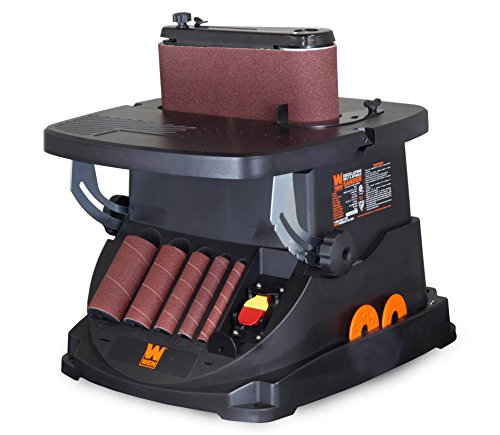 WEN 6524 Oscillating Belt and Spindle SanderCheck Amazon offer
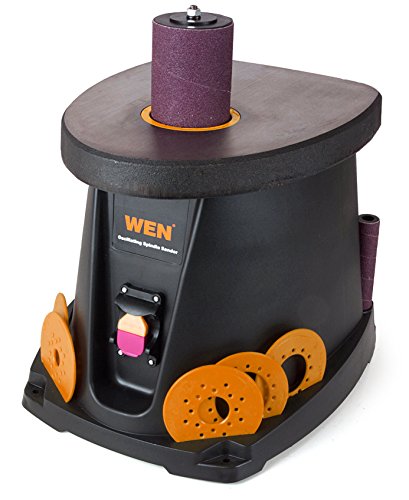 WEN 6510T 3.5 Amp Oscillating Spindle Sander,BlackCheck Amazon offer
Documented specifications for Grizzly G0538
| Model | Family | Sleeve height (in) | Diameters (in) | Belt size | Table tilt | Offer |
|---|---|---|---|---|---|---|
| Grizzly G0538 | spindle | 4.5 | 0.5, 0.75, 1, 1.5, 2, 3 | None documented | 0° | No exact offer matched |
- Machine weight
- 34 lb
- Documented spindle speed
- 1725 RPM
- Dust port
- 2.5 in
Manual applies to machines manufactured since December 2009; data sheet dated August 2013.
August 16, 2026 sheet calls the motor capacitor-start induction; older current-hosted manual calls it universal. Treat construction as revision-dependent.
Six sleeves but five rubber drums: the 1/2 in. sleeve mounts directly to the spindle.
Table documented as particle board with plastic laminate.
US documentation specifies 110V.
The table construction deserves a closer look
Grizzly documents a 20-by-14-inch particleboard table with plastic laminate, 34-pound weight, 1725-RPM spindle speed, 72 oscillations per minute and a 5/8-inch stroke. Six 4-1/2-inch sleeves span 1/2 to 3 inches, while five rubber drums support the sizes from 3/4 through 3 inches. The August 16, 2026 specification sheet calls the motor a capacitor-start induction design; the older current-hosted manual calls it universal. Treat that as revision-dependent evidence, not a conflict to resolve by choosing the newer-sounding description.
Think about sliding support rather than material prestige
A table material is one attribute of a sanding station, not a complete quality ranking. For a shaped wooden component, the immediate needs are adequate support, a surface that allows controlled movement, and a reliable reference to the abrasive. Run a straightedge over the relevant work region with the machine disconnected and inspect for raised damage that could cause rocking. Consider how a wide bracket will sit as its internal curve approaches the drum. If only a small corner remains supported late in the pass, the problem is the workpiece geometry and setup rather than a lack of tabletop area measured at the widest point.
Plan a radius progression for mixed curves
The G0538’s small sleeve sizes address tight recesses, while the larger options are relevant to more open concave profiles. A useful approach is to study the outline before starting and mark places where the curvature changes noticeably. Refine the broad sections using a suitable diameter, then change for tighter details as the manual permits. Preserve a little material near the transitions until both adjoining curves are established. This reduces the temptation to dig out a local region merely because it still shows a saw mark. Compare the overall silhouette frequently; a uniformly clean surface is not proof that the intended curve has been preserved.
The dust connection changes the installation plan
The manufacturer manual specifies a 2-1/2-inch dust port. That figure can be useful when comparing the G0538 with machines using smaller connections, but a larger nominal opening alone does not demonstrate better collection. Actual extraction depends on the collector, hose, fittings, and how dust is captured at the work. Measure the mating end of the proposed hose or adapter and preserve room for a secure connection. Avoid designing a cabinet around the bare footprint while leaving no space to disconnect the hose for maintenance. Check the manual for collection requirements and include that equipment in the cost and space assessment.
Use the correct generation of the manual
The linked G0538 manual identifies machines manufactured since December 2009, while the separate current specification sheet is dated August 16, 2026. That timeline helps explain why motor-construction wording should stay qualified. Record the manufacture date, serial number and nameplate before requesting service parts. For replacement abrasives, confirm the current model-specific listing rather than treating a historic accessory table as a live inventory promise. Keep inserts, drum washers and rubber drums paired in storage; matching sleeve dimensions alone do not prove that a mechanical assembly belongs to this revision.
Protect the reference face during planning
Before using the G0538 on a finished or veneered component, consider whether sliding its reference face across the table could mark a surface that is already complete. Sequence construction so vulnerable finishing generally follows shaping where practical. If the project requires a different order, establish an appropriate method on scrap rather than discovering a support or surface-contact problem on the final piece.
Questions about Grizzly G0538 Spindle Sander Guide
Does the G0538 have a cast-iron table?
The cited manufacturer manual specifies particle board with plastic laminate for the table. Check the exact machine revision before assuming specifications from another Grizzly spindle sander apply.
What abrasive sizes are documented?
The manual lists six diameters from 1/2 through 3 inches in a 4-1/2-inch format. Verify a current replacement product’s explicit fit and construction before ordering, especially for an older machine.
Does higher oscillation count prove a better finish?
No. The published motion rate describes the mechanism. Abrasive condition, grit, workpiece support, material, and feed technique also affect the result; this guide does not claim a tested finish ranking.